This is the state-by-state companion to our hot tub draining guide. That guide covers how to drain a tub. This one covers where the water is allowed to go, state by state, built from the source-checked draining rule on each of our 605 city guides.
Key takeaways
- Local rules decide. State agencies set the baseline, usually "dechlorinate first", but bans on the storm drain are written by cities and counties.
- Across 605 cities: 358 allow dechlorinated water to the storm drain, 111 ban it even when dechlorinated, and 136 are unclear.
- Most bans: Arizona (41% of our cities), Florida (35%) and California (24%). No bans among our cities in Washington, Maryland, Missouri, Tennessee or Wisconsin.
- The lawn dominates in some states: 67 of 68 Florida cities, all 25 Michigan cities and all 19 Virginia cities point to your own lawn.
- The sewer is required in 28 cities, 19 of them in California.
Can I drain my hot tub in the street?
Sometimes. The street gutter leads to the storm drain, and storm drains usually flow to creeks, lakes or the ocean without treatment. So the street rule and the storm drain rule are the same rule. Here's what the 605 cities in our guides say:
- 358 (59%) allow it only after the water is dechlorinated, often with a chlorine limit, a pH range or a slow flow. Many still prefer the lawn or sewer.
- 111 (18%) ban spa or pool water from the street or storm drain even when it's dechlorinated.
- 136 (22%) are unclear: no local rule, or one that doesn't settle the question. Treat unclear as "ask first", not "anything goes".
Before you run a hose to the curb, find your city below or on your city page. Even where the street is allowed, it's usually the last resort.
Hot tub draining rules by state: summary table
Counts of cities in our guides, not every city in the state. "Sewer" and "Lawn" count cities where that route is allowed, preferred or required; a city can name more than one route. The numbers match the state table in our drain guide.
| State | Cities | Storm drain after dechlorination | Storm drain banned | Unclear | Sewer | Lawn | Share banning storm drain |
|---|---|---|---|---|---|---|---|
| Arizona | 27 | 14 | 11 | 2 | 21 | 23 | 41% |
| California | 152 | 97 | 36 | 19 | 91 | 48 | 24% |
| Colorado | 20 | 7 | 2 | 11 | 5 | 3 | 10% |
| Florida | 68 | 22 | 24 | 22 | 23 | 67 | 35% |
| Georgia | 15 | 6 | 1 | 8 | 3 | 1 | 7% |
| Illinois | 30 | 16 | 3 | 11 | 4 | 8 | 10% |
| Indiana | 18 | 13 | 2 | 3 | 1 | 2 | 11% |
| Maryland | 17 | 5 | 0 | 12 | 14 | 3 | 0% |
| Michigan | 25 | 16 | 3 | 6 | 1 | 25 | 12% |
| Minnesota | 22 | 10 | 4 | 8 | 3 | 15 | 18% |
| Missouri | 16 | 14 | 0 | 2 | 3 | 2 | 0% |
| North Carolina | 19 | 14 | 2 | 3 | 3 | 18 | 11% |
| Ohio | 22 | 12 | 4 | 6 | 4 | 4 | 18% |
| Oregon | 11 | 9 | 2 | 0 | 11 | 9 | 18% |
| Tennessee | 16 | 14 | 0 | 2 | 3 | 3 | 0% |
| Texas | 73 | 44 | 14 | 15 | 19 | 16 | 19% |
| Virginia | 19 | 13 | 3 | 3 | 7 | 19 | 16% |
| Washington | 24 | 22 | 0 | 2 | 21 | 11 | 0% |
| Wisconsin | 11 | 10 | 0 | 1 | 0 | 11 | 0% |
| All 19 states | 605 | 358 | 111 | 136 | 237 | 288 | 18% |
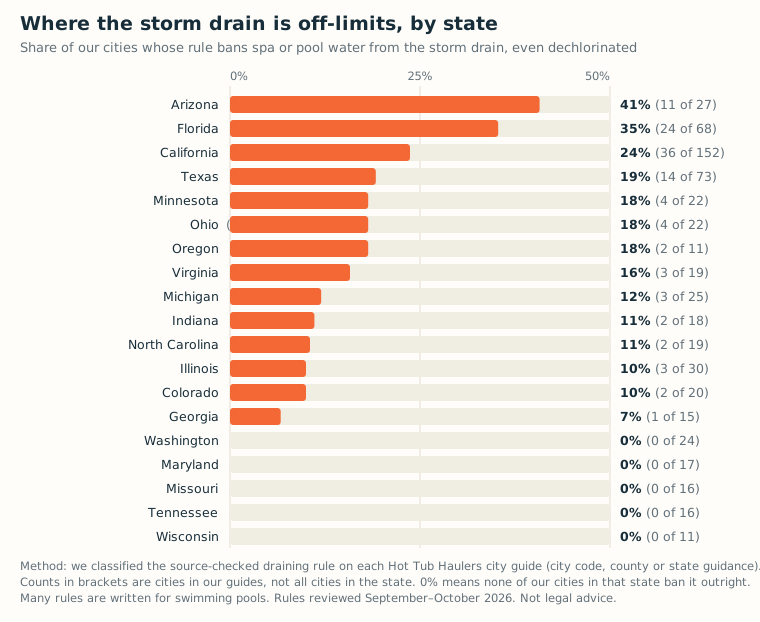
Three patterns stand out. Desert and coastal states ban the street most: Arizona cities send spa water to landscaping or the sewer clean-out, and many Florida cities allow nothing but rain in their storm drains. Washington is the opposite: 22 of 24 cities allow dechlorinated water to the storm drain, almost all at 0.1 ppm or less. And in Maryland, Colorado and Georgia most of our cities are unclear, because local codes defer to state guidance or exempt only "pollutant-free" water without saying what that means for a spa.
Rather not deal with it? We remove hot tubs from $349 — cut-down, haul-away and disposal included.
Get a hot tub removal quote ↗State-by-state draining rules
Arizona: drain hot tub water onto landscaping or into the sewer clean-out
27 cities: 14 allow dechlorinated water to the storm drain, 11 ban it, 2 unclear. 21 allow the sewer and 23 allow or prefer your own landscaping.
State and county guidance: our Arizona rules rely on city and county guidance rather than a single state document. Maricopa County Stormwater says to use your sewer clean-out or keep the water on your own property. Pima County's guidelines allow dechlorinated spa water (below 1 ppm) on your own landscaping or a curbed paved road, never an unpaved road or a septic system. Mesa notes that street draining may violate city code unless it meets ADEQ's De Minimis permit conditions.
- Phoenix: no pool water in storm drains. Use the house sewer clean-out at no more than 12 gallons per minute, or salt-tolerant landscaping. The right-of-way needs a permit.
- Tucson: your own sewer clean-out or landscaping first. The street only if you have no private clean-out and meet every condition, including 72 hours untreated and pH 7–8.
- Mesa: landscaping or the sewer clean-out at about 12 gallons a minute; neither needs a permit.
California: drain hot tub water to the sewer or landscaping
152 cities: 97 allow dechlorinated water to the storm drain, 36 ban it, 19 unclear. 91 allow or require the sewer (required in 19), and 48 allow the lawn. The most common chlorine limit is 0.1 mg/L.
State guidance: the State Water Resources Control Board's residential BMPs advise draining pool or spa water to the sanitary sewer after calling the local treatment plant, or dechlorinating it and using it on the lawn. Regional stormwater permits go further. The Bay Area permit bars spa water with chlorine, copper algaecide or other pollutants from storm drains, which is why many Bay Area cities require the sewer. In the Los Angeles region, the regional MS4 permit, as cited by West Covina, allows pool and spa water only once it's dechlorinated to 0.1 mg/L or less, pH 6.5–8.5 and flow-controlled.
- San Jose: never the street, gutter or storm drain. Use a sanitary sewer clean-out.
- Los Angeles: dechlorinated spa water is conditionally exempt from the storm drain ban. Ask LA Sanitation first.
- Sacramento: pump slowly to a sewer clean-out after contacting your sewer agency. The storm drain only under strict limits, including chlorine below 0.01 ppm.
- San Diego: lawn or landscape over several days, or the sewer with approval. Fines run up to $10,000 a day.
Colorado: no detectable chlorine, and notify first
20 cities: 7 allow dechlorinated water to the storm drain, 2 ban it, 11 unclear. 5 allow the sewer and 3 the lawn.
State guidance: Colorado's pool and spa discharge guidance (revised 2015) requires clear water with no detectable chlorine or bromine and no cleaning chemicals. It asks you to notify the storm-system owner before a storm discharge and to get the utility's permission for the sanitary sewer. Many Colorado cities simply defer to it, which is why so many are unclear.
- Denver: follows the state guidance. Agree on a discharge route before you drain.
- Colorado Springs: lists residential pool and hot tub discharges as allowable to its storm system, if they meet the state's no-detectable-chlorine standard.
- Longmont: dechlorinate, test, then drain slowly onto lawn or landscaping so nothing reaches the street.
Florida: drain hot tub water slowly over grass
68 cities: 22 allow dechlorinated water to the storm drain, 24 ban it, 22 unclear. 67 point you to the lawn; 23 allow the sewer and 12 bar it.
State guidance: Florida DEP's stormwater BMP says to let the water stand at least 48 hours after the last chlorine, or use a neutralizer such as sodium thiosulfate, until chlorine is 0.01 mg/L or less. Keep the pH between 6.5 and 8.5 and spread the water slowly over grass. 44 of our Florida cities use that 0.01 mg/L line.
- Miami: Miami-Dade County allows nothing but rainwater into storm drains. Use the lawn.
- Tampa: pool discharges must be dechlorinated before they reach the storm sewer.
- Tallahassee: only stormwater in the City storm sewer unless an exemption or permit applies. Run it over grass.
- Orlando: no chemicals in storm drains. Orange County adds: never drain a spa into a septic system.
Georgia: mostly unclear, so ask your city
15 cities: 6 allow dechlorinated water to the storm drain, 1 bans it, 8 unclear. 3 allow the sewer and 1 the lawn.
State guidance: Georgia EPD's municipal stormwater permits, including the Phase II general permit, list swimming pool discharges among flows local programs must address only if they're a significant source of pollutants. That leaves the detail to cities, and many don't publish one.
- Atlanta: polluted water is banned from storm drains, and pool water isn't on the exempt list. Call Watershed Management before you drain.
- Mableton: Cobb County says never the street, storm drain or a septic system. Ask your sewer provider, or drain slowly onto your lawn at 0.1 mg/L or less.
- Savannah: dechlorinated swimming pool discharges are exempt; spas aren't named, so call 311.
Illinois: dechlorinated and pH-neutral
30 cities: 16 allow dechlorinated water to the storm drain, 3 ban it, 11 unclear. 4 allow the sewer (2 require it), 6 bar it, and 8 allow the lawn.
State guidance: Illinois EPA's general permit for small MS4s (ILR40) allows only dechlorinated, pH-neutral swimming pool discharges into storm sewers. Kane County's guidance covers hot tubs: dechlorinate, or let the water sit at least 2 days in the sun and test below 0.1 mg/L, then drain across your lawn.
- Naperville: dechlorinated, pH-neutral pool water is exempt from the storm drain ban; the City doesn't say whether that covers hot tubs.
- Chicago: no hot tub rule. Deep backyard pools must drain to the sewer, never during a rainstorm.
- Aurora: nothing into storm drains. Follow Kane County's lawn guidance.
Indiana: dechlorinated pool water tolerated, hot tubs rarely named
18 cities: 13 allow dechlorinated water to the storm drain, 2 ban it, 3 unclear. 1 requires the sewer and 2 allow the lawn.
State guidance: IDEM's MS4 general permit (INR040000) lists dechlorinated or debrominated residential pool discharges among non-stormwater flows a city may allow. It doesn't name hot tubs, and some cities are stricter.
- Indianapolis: dechlorinate, then the sanitary or combined sewer. Only with no sewer available, your own ground at least 10 feet from property lines, sidewalks and streets.
- Fort Wayne: draining pool, spa or hot tub water to a storm drain is against the law. Drain slowly onto grass over more than one day.
- Carmel: dechlorinated pool water (typically under 1 ppm) is exempt, but call Engineering first.
Maryland: the sanitary sewer is the best option
17 cities: 5 allow dechlorinated water to the storm drain, none ban it, 12 unclear. 14 allow or prefer the sewer and 3 the lawn.
State guidance: the Maryland Department of the Environment's pool owner guidance covers spas. It calls the sanitary sewer the best option, with your sewer authority's permission. It says not to drain while you can still measure chlorine, to keep the pH between 6.0 and 9.0, and to drain slowly with a low-volume pump or siphon. MDE also runs a general permit for pool and spa discharges (17-SI). In 9 of our Maryland cities, the city has no rule of its own, so their pages rely on state or county guidance.
- Baltimore: pool water may go to the sanitary sewer only with a Public Works permit, where storm drains aren't available. Ask 311.
- Rockville: residential pool water under 1 ppm chlorine is exempt from the storm drain ban.
- Bethesda: Montgomery County requires no permit for a home pool, but the water must meet its criteria, including chlorine no higher than 0.1 ppm reaching streams.
Michigan: let it sit about two weeks, then drain to the ground
25 cities: 16 allow dechlorinated water to the storm drain, 3 ban it, 6 unclear. All 25 point to your own lawn; 1 allows the sewer.
State guidance: Michigan EGLE's guidance covers residential hot tubs by name. Leave the tub uncovered in sunlight for about two weeks, or until testing shows no chlorine or bromine, then drain it onto the ground and keep it on your property, not in a septic system. If a storm sewer is the only option, cool the water and keep filter backwash out. A saltwater tub needs an EGLE permit before draining to a storm sewer.
- Novi: a rule written for hot tubs. Neutralize the water, by waiting 7 to 10 days or using a dechlorinator, then yard, pavement or storm drain.
- Ann Arbor: nothing but stormwater in the storm system without a City permit. Drain to the ground.
- Grand Rapids: dechlorinated pool water from one- to three-family homes is exempt from the storm drain ban.
- Detroit: no city rule; follow EGLE.
Minnesota: stop chlorinating three days ahead, then the lawn
22 cities: 10 allow dechlorinated water to the storm drain, 4 ban it, 8 unclear. 15 point to the lawn; 3 allow the sewer (1 requires it).
State guidance: the Minnesota Pollution Control Agency says to stop chlorination three days before discharge and to put chlorine-free water on a vegetated surface so it soaks in. It says chlorinated water should never go to a storm sewer, ditch, lake or wetland. It also says hot tubs' smaller volumes make them "less of a problem" than pools, but chlorine must still be minimized first.
- Minneapolis: the private pool ordinance calls for emptying to the sanitary sewer and bars the street.
- Bloomington: no chlorine the week before, test that chlorine is undetectable and pH is 6.5–7.8, then pump over a lawn.
- St. Paul: no city page; Ramsey County accepts dechlorinated water in storm drains.
Missouri: no permit for a single-family home, but dechlorinate
16 cities: 14 allow dechlorinated water to the storm drain, none ban it, 2 unclear. 3 allow the sewer and 2 the lawn.
State guidance: the Missouri DNR's general permit for pool discharges (MO-G760000) counts hot tubs as pools and exempts single-family homes from needing a permit. The state's storm sewer permits allow only dechlorinated, uncontaminated residential pool water. Around St. Louis, the Metropolitan St. Louis Sewer District sets the detail.
- St. Louis: MSD allows spa water to a storm inlet or gutter only when chlorine is low, the water is clear and the pH is 5.5–11.5.
- Kansas City: dechlorinated pool water, no more than 1 mg/L chlorine, is an allowed discharge.
- Springfield: no chemicals, soaps or heated water in the storm sewer; dechlorinated pool water is allowed.
North Carolina: the lawn, away from streams
19 cities: 14 allow dechlorinated water to the storm drain, 2 ban it, 3 unclear. 18 allow the lawn; 3 allow the sewer and 4 bar it.
State guidance: NC DEQ rule 15A NCAC 02T .0113 treats spa drainage to the land surface as permitted, as long as nothing discharges directly to surface waters.
- Raleigh: not into the stormwater system. Wait at least 10 days, dechlorinate as close to 0.0 ppm as you can, release slowly to grass.
- Charlotte: hot tub water may be discharged only with no chlorine, bromine, salt or other chemicals.
- Durham: dechlorinated swimming pool discharges are allowed; hot tubs aren't named.
Ohio: rest the water 48 hours, and local rules may be stricter
22 cities: 12 allow dechlorinated water to the storm drain, 4 ban it, 6 unclear. 4 allow the sewer (1 requires it) and 4 the lawn.
State guidance: Ohio EPA allows dechlorinated pool water in a storm sewer unless it adds significant pollutants, recommends resting the water 48 hours or more first, and notes that local rules may be stricter. Several big cities are.
- Columbus: hot tubs count as pools. Use the sanitary sewer, or your own garden and lawn.
- Cincinnati: test below 0.1 mg/L, then drain slowly over open grass, not into a stream or storm sewer.
- Cleveland: the sewer code bars swimming pool water from the sewer and stormwater systems. Call 311 first.
- Toledo: dechlorinated pool water is exempt; the local stormwater coalition says the sanitary drain is best.
Oregon: the sanitary sewer is often best
11 cities: 9 allow dechlorinated water to the storm drain, 2 ban it, none unclear. All 11 allow or prefer the sewer, and 9 allow the lawn. Every rule covers spas.
State guidance: the Oregon DEQ fact sheet on chlorinated pool and hot tub water calls the sanitary sewer often the best option and says to get your local wastewater provider's authorization first.
- Portland: no heated, chlorinated or salt water in storm drains. The sanitary sewer needs no prior approval for a home pool.
- Eugene: onto a lawn where it soaks in, never the street or a storm drain. Let it sit a week first.
- Gresham: no pool or hot tub water in storm drains, even dechlorinated. Use the sewer, or grass or gravel that soaks it up.
Tennessee: dechlorinated water allowed, the sewer preferred where offered
16 cities: 14 allow dechlorinated water to the storm drain, none ban it, 2 unclear. 3 allow the sewer (1 requires it) and 3 the lawn.
State guidance: TDEC's small MS4 general permit (TNS000000) lists dechlorinated swimming pool discharges among non-stormwater flows allowed in storm sewers.
- Nashville: the sanitary sewer whenever possible; otherwise let it stand 7 to 10 days, then drain slowly onto your grass.
- Memphis: no chlorinated or heated water in the storm sewer; dechlorinated pool water is allowed.
- Germantown: water with chemicals must go to the sanitary sewer, not the ground or the storm drain.
Texas: dechlorinated pool water allowed unless your city says no
73 cities: 44 allow dechlorinated water to the storm drain, 14 ban it, 15 unclear. 19 allow the sewer (3 require it) and 16 the lawn. The most common chlorine limit is 1 ppm.
State guidance: TCEQ's small MS4 general permit (TXR040000) lists dechlorinated swimming pool discharges as allowable unless a city prohibits them. Fourteen of our Texas cities do.
- Garland: pools, hot tubs and spas must drain to a sanitary sewer, not grass, alleys, streets or storm drains.
- Houston: the city's spa demolition specifications say not to drain into a storm sewer.
- Dallas: no pool water with 1 mg/L or more chlorine in storm drains, and none at all from a pool within 200 feet of a wastewater access point.
- Austin: the storm drain only if free of chlorine and salt, with pH 6.0–10.5.
Virginia: the sewer or well-vegetated ground, storm drain last
19 cities: 13 allow dechlorinated water to the storm drain, 3 ban it, 3 unclear. All 19 point to the lawn; 7 allow the sewer.
State guidance: Virginia DEQ's pool water guidelines count hot tubs as pools. They prefer the sanitary sewer; otherwise release the water onto well-vegetated ground on your property, with storm drains a last resort. The water should have no detectable chlorine or bromine (above 0.10 mg/L) and a pH of 6.0 to 8.0, and be cooled. Salt water shouldn't be released. Fairfax County adds a 25 gallons per minute maximum.
- Burke (Fairfax County): sit 7 to 10 days or neutralize, test below 0.1 mg/L, drain over grass.
- Virginia Beach: significant quantities of pool water are banned from the public sewer. Use well-vegetated ground.
- Portsmouth: nothing but stormwater in the stormwater system, with fines up to $1,000.
Washington: 0.1 ppm or less, and the sewer is best
24 cities: 22 allow dechlorinated water to the storm drain, none ban it, 2 unclear. 21 allow or prefer the sewer (3 bar it), and 11 allow the lawn. Every rule covers spas; 23 use a 0.1 mg/L chlorine limit.
State guidance: Washington's Department of Ecology says to let pool water sit a week or longer, calls the sanitary sewer "the best place" for it, and names your yard as next best, and the best choice if you have a septic system. Its focus sheet says not to pour pool or spa water into storm drains, which is stricter than the 22 city rules that allow dechlorinated water there. Follow your city's rule, and use the sewer or yard when you can.
- Seattle: spa water should go to the sanitary sewer; a storm drain only at 0.1 ppm or less and pH-adjusted.
- Bellevue: four legal ways, from a draining service to the sewer through to the street as a last resort.
- Spokane: storm drains at 0.1 ppm or less; the sanitary sewer only with the Plant Manager's OK.
- Tacoma: the sewer when you can; the storm system only if that isn't possible.
Wisconsin: let it sit in the sun, drain over grass
11 cities: 10 allow dechlorinated water to the storm drain, none ban it, 1 unclear. All 11 point to the lawn; 3 bar the sanitary sewer.
State guidance: the Wisconsin DNR recommends letting the water sit at least 6 to 8 hours in direct sunlight, checking the pH is near 7, and draining slowly over a well-vegetated area of your own property, not by hose straight into a storm sewer. The sanitary sewer is an option only where your municipality allows it, and the DNR strongly recommends against a septic system.
- Milwaukee: dechlorinated pool water is exempt from the storm water ban.
- Madison: a residential pool may drain to the storm sewer once no chemicals have been added for two weeks.
- Kenosha: spa water may not enter any sanitary sewer; the storm sewer exemption needs chlorine below 1 ppm.
Before you drain, wherever you live
- Find your city's rule. Use the state sections above or your city page. If it's unclear, call the city's stormwater or public works office.
- Turn the spa off at the breaker. See how to drain a hot tub for the full steps.
- Dechlorinate and test to your local limit. See how to dechlorinate hot tub water.
- Drain slowly, and keep it on your property unless the sewer or storm drain is allowed.
- On a septic system? Keep it out of the tank and off the drainfield. See draining a hot tub on a septic system.
- Salt-water spas often have their own rules; several states and cities bar salt water from storm drains.
Methodology
Each of our 605 city guides carries a source-checked "Draining" rule, built from that city's code or stormwater page and from county or state guidance where the city defers to it. Every rule links its sources, and the rules were reviewed in September and October 2026. We read every rule and recorded what it says about three routes: the storm drain or street, the sanitary sewer (including household drains and clean-outs), and your own lawn or landscaping.
- Storm drain after dechlorination: the local rule clearly lets dechlorinated spa or pool water go to the storm drain or street, even if only as a last resort or with conditions.
- Storm drain banned: the rule says spa or pool water may not go there at all, even dechlorinated.
- Unclear: no local rule, or one that doesn't settle the question. We didn't guess. Cities that rely on state guidance only are counted here.
- Sewer and Lawn count cities where that route is allowed, preferred or required. A city can name several routes, so these columns don't add up to the city total.
Many rules are written for swimming pools and don't name spas; in 304 of the 605, the rule or the guidance it cites explicitly covers spas or hot tubs. The counts describe the cities in our guides, not every city in each state, and the same method underlies the numbers in our drain guide. This is a summary, not legal advice. Rules change, so confirm with your city before you drain.
Draining because the tub is going?
Drain it if you can; tell us if you can't, and we'll talk it through. After that comes the heavy part: cutting it down, carrying it out and disposing of it. See how to get rid of a hot tub, whether your city will take one, and our pricing.
Rather not deal with it? We remove hot tubs from $349 — cut-down, haul-away and disposal included.
Get a hot tub removal quote ↗Frequently asked questions
Where can I drain my hot tub?
Wherever your city allows, usually your own lawn, the sanitary sewer through a clean-out, or the storm drain after dechlorination. In the 605 cities in our guides, 288 allow or prefer the lawn, 237 allow or require the sewer and 358 allow dechlorinated water to the storm drain.
Can I drain my hot tub in the street?
In many cities, only after it's dechlorinated, and in some not at all. 111 of the 605 cities we checked ban spa or pool water from the street or storm drain even when it's dechlorinated, including Phoenix, San Jose, Garland and Minneapolis.
Which states ban draining a hot tub into the storm drain?
In our data, outright bans come from cities and counties, not state agencies. The share of our cities with a ban is highest in Arizona (11 of 27) and Florida (24 of 68). None of our cities in Washington, Maryland, Missouri, Tennessee or Wisconsin ban it outright, though all expect the water to be dechlorinated.
Can I drain my hot tub in California?
Usually to the sanitary sewer or landscaping, and to the storm drain only if your city allows dechlorinated water. Of 152 California cities in our guides, 97 allow dechlorinated water to the storm drain, 36 ban it and 91 allow or require the sewer. Many Bay Area cities require the sewer.
Do I need a permit to drain a hot tub?
Usually not for a home spa, but some places require notice or approval for certain routes. Colorado guidance asks you to notify the storm-system owner first, Phoenix requires a permit for the right-of-way, and Missouri's pool discharge permit exempts single-family homes.
How clean does hot tub water need to be before draining?
Dechlorinated, and often tested. Where our cities set a limit, the most common is no detectable chlorine, then 0.1 mg/L. Florida DEP guidance asks for 0.01 mg/L or less, and many rules add a pH range such as 6.5 to 8.5.
Sources
- California State Water Resources Control Board: BMPs for Residential Sources (PDF)
- San Francisco Bay Regional Water Board: Municipal Regional Stormwater Permit, Order R2-2022-0018 (PDF)
- LA Regional Water Board: Regional MS4 Permit, Order R4-2021-0105 (PDF)
- TCEQ: Small MS4 General Permit TXR040000 (PDF)
- Florida DEP: Stormwater Pollution Prevention BMP, swimming pool discharges (PDF)
- Illinois EPA: General Storm Water Permit for Small MS4s (ILR40)
- Kane County, IL: Guidelines for Draining Swimming Pools (PDF)
- Maricopa County Stormwater: Residential pollution prevention (PDF)
- Pima County PDEQ: Draining Your Swimming Pool & Spa (PDF)
- Michigan EGLE: Disposal of residential wastewater such as swimming pool water
- Washington Department of Ecology: Do's and Don'ts of Draining your Pool (PDF)
- Minnesota Pollution Control Agency: Swimming Pool and Hot Tub Water Discharges BMPs (PDF)
- Ohio EPA: Discharging swimming pool water into storm sewers
- Colorado pool/spa discharge guidance, revised 2015 (PDF, hosted by Larimer County)
- NC DEQ: 15A NCAC 02T, Rule .0113 (PDF)
- Virginia DEQ: Guidelines for the Release of Swimming Pool Water (2012; copy filed by Fairfax County) (PDF)
- Fairfax County: Proper Discharge of Swimming Pool Water
- IDEM: MS4 General Permit INR040000 (PDF)
- Maryland Department of the Environment: Swimming Pool Owner Guidance (PDF)
- Maryland Department of the Environment: General Permit for Discharges from Swimming Pools and Spas (17-SI)
- Missouri DNR: General Permit MO-G760000, Swimming Pools and Water Features (PDF)
- Metropolitan St. Louis Sewer District: Safely Draining Pools & Spas
- TDEC: NPDES General Permit for Small MS4s, TNS000000 (PDF)
- Georgia EPD: General Phase II NPDES Stormwater Permit GAG610000 (PDF)
- Georgia EPD: Municipal Stormwater
- Oregon DEQ: Fact Sheet, Disposing Chlorinated Water from Swimming Pools and Hot Tubs (PDF)
- Wisconsin DNR: Best Management Practices for the Disposal of Residential Swimming Pool Water (PDF)
- Hot Tub Haulers city guides: draining rules for 605 US cities, reviewed September–October 2026