Key takeaways
- Breaker off first. Hot Spring's manual says to disconnect the spa from power before draining; Jacuzzi warns that running pumps or heaters dry "even briefly" can damage them.
- Two ways to drain: the built-in drain spigot and a garden hose (30–90 minutes for a 300–400 gallon spa, per Jacuzzi), or a submersible pump (10–15 minutes with a 2,000–3,000 GPH pump).
- How often: every three to four months for most acrylic spas (Jacuzzi); about four months, depending on soap build-up (Hot Spring).
- Where the water goes is a legal question. Across the 605 cities in our guides, 111 bar spa or pool water from the storm drain even when it's dechlorinated, and 358 allow it only once it's dechlorinated.
- Dechlorinate, check the pH, drain slowly. Where our cities set a chlorine limit, the most common is "no detectable chlorine", then 0.1 mg/L.
What you need
- A garden hose long enough to reach your discharge point. Jacuzzi notes a 3/4-inch hose drains faster than a 5/8-inch one.
- Optional: a submersible utility pump with a garden-hose outlet.
- A wet/dry vacuum or sponge for the last inch.
- Chlorine/bromine and pH test strips.
- Optional: a spa line-flush product, and filter cleaner.
How to drain a hot tub, step by step
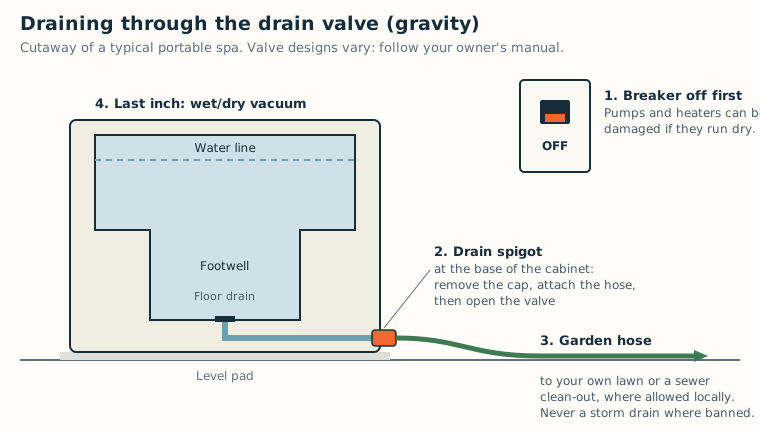
1. Check where the water is allowed to go
Do this before you open anything. A 300–400 gallon spa is a lot of chemically treated water, and many cities regulate where it can go. Look up your city in the rules section below, or on your city page.
2. Flush the lines (optional, before draining)
Jacuzzi recommends running a line flush or spa flush product through the system before you drain, to help remove biofilm and debris from the plumbing. Follow the product label. This step happens while the water is still in and the pumps can still run, so do it before you cut the power.
3. Turn the power off at the breaker
Switch the spa off at its control panel, then switch off its dedicated breaker. Hot Spring's manual says to disconnect the spa from power before draining, by tripping the GFCI breakers in the subpanel (or unplugging a 115V model). Jacuzzi explains why: running the pumps and heater dry, "even briefly", can cause serious damage to seals, impellers and heating elements. If you're draining because the tub is being removed, the circuit also has to be disconnected by a licensed electrician before removal day. See how the disconnection works.
4. Find the drain valve
Most portable spas have a drain spigot near the base of the cabinet, usually behind or below a front panel. Hot Spring puts it at the lower front of the spa. Designs vary, so check your manual. Some valves have a cap to unscrew, then a knob or valve body to turn or pull.
5. Attach the hose and open the valve
Screw a garden hose onto the spigot and run it to your discharge point. Hot Spring says to use the hose to avoid flooding the foundation around the spa, and warns that water with a high sanitizer level may harm plants and grass. Then open the valve. The tub drains by gravity.
6. Or use a submersible pump
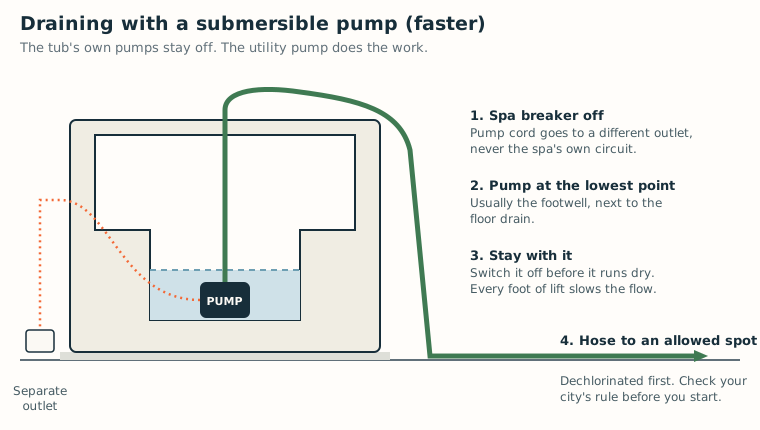
A pump is much faster. Set it on the lowest point of the footwell, attach the hose, run the hose over the rim to your discharge point, and plug the pump into a separate outlet (the spa's own circuit is off). Jacuzzi says to stay with it so the pump doesn't run dry. You can also start a siphon with a wet/dry vacuum, but it is slower and fussier than a pump.
7. Get the last inch out
Neither method gets every drop. Hot Spring says its spas drain through the floor drain and to use a shop vac to remove the remaining water. Water left in the plumbing only needs removing if you're winterizing.
8. Clean the filters and the shell
While the tub is empty, take the filters out. Jacuzzi says to rinse each filter with a garden hose from top to bottom; Hot Spring says to install a new filter or clean the existing one with filter cleaner. Wipe the shell with a spa-safe cleaner. Jacuzzi warns against bleach, ammonia and household glass cleaners, which can damage acrylic and gaskets.
9. Refill through the filter well
Close the drain valve and put the cap back. Refill through the filter compartment, not over the rim: Jacuzzi says this floods the pump and plumbing first and pushes air out, which helps prevent airlocks. Hot Spring adds that refill water should be between 50°F and 70°F to avoid tripping the high-limit sensor, and doesn't recommend refilling when the air is below 50°F. Restore power only when the tub is full.
Drain valve or pump: which to use
| Drain valve + hose | Submersible pump | |
|---|---|---|
| Time for 300–400 gal (Jacuzzi) | 30–90 minutes | 10–15 minutes (2,000–3,000 GPH pump) |
| Extra equipment | Garden hose | Pump, hose, separate outlet |
| Attention needed | Low; check now and then | Stay with it; don't let it run dry |
| Flow control | Slow, steady flow | Fast; can be too fast for some rules |
| Best for | Routine water changes, lawns, slow-flow rules | Draining before a removal or move |
Slow can be a feature. Fairfax County, Virginia, recommends draining at 12–15 gallons per minute with a maximum of 25 gallons per minute to storm drains or streams, to prevent erosion. A 2,000 GPH pump moves about 33 gallons per minute, which is over that limit.
How long does it take to drain a hot tub?
Drain time is simply the tub's volume divided by the flow rate. You need two numbers:
- Volume. It's in your manual's spec table. Hot Spring's two-seat Hot Spot TX holds 190 gallons and the three-seat SX holds 230 gallons. Many family-size spas hold more; Jacuzzi's timing figures assume 300–400 gallons.
- Flow. Pumps are rated in gallons per hour (GPH), and the rating drops with lift. Wayne's TSC130, a 1/4 HP utility pump with a garden-hose outlet, is rated at 1,250 GPH at 0 feet and 1,000 GPH at 10 feet of discharge lift.
Drain time (minutes) = gallons ÷ GPH × 60.
| Tub | Gallons | 1/4 HP pump at 1,000 GPH | 1/4 HP pump at 1,250 GPH | Gravity (Jacuzzi's range) |
|---|---|---|---|---|
| Hot Spring Hot Spot TX | 190 | about 11 min | about 9 min | 30–90 min for 300–400 gal |
| Hot Spring Hot Spot SX | 230 | about 14 min | about 11 min | |
| Typical 400-gallon spa | 400 | about 24 min | about 19 min |
These are pump-only times at the rated flow. Hose length, a narrow hose and the last few inches (where most pumps slow down) add time. Wayne says the TSC130 removes water down to 1/8 inch, which still leaves the footwell to vacuum. If your city sets a maximum flow rate, it wins over speed.
How often should you drain a hot tub?
Follow your manufacturer. Two of the biggest brands say:
- Jacuzzi: most portable Jacuzzi hot tubs and similar acrylic spas should be drained every three to four months, or at least three times a year.
- Hot Spring: when soap build-up makes the water feel unclean, "it's time to drain and refill"; depending on soap input, the water should last about four months.
Hot Spring also recommends draining or winterizing if the spa will sit unused and unmaintained for more than 14 days. Hot Spring's troubleshooting table also lists a drain, clean and refill as the fix for a severe scum ring, scale and a persistent musty odor. Each water change means a discharge, so the local rules below apply every time, not only at removal.
Draining before a hot tub removal
Drain it fully if you can. Water weighs about 8.34 pounds per gallon, so a 400-gallon spa holds over 3,300 pounds of it, and a spa can't be cut down or moved safely while it's full. (See how much a hot tub weighs.) For a removal:
- Start a few days ahead if your city's rule needs the chlorine to fade on its own.
- Drain to the allowed spot, then vacuum the footwell.
- Leave the cover off so it can dry, and take the filters out.
- Have a licensed electrician disconnect the circuit before removal day.
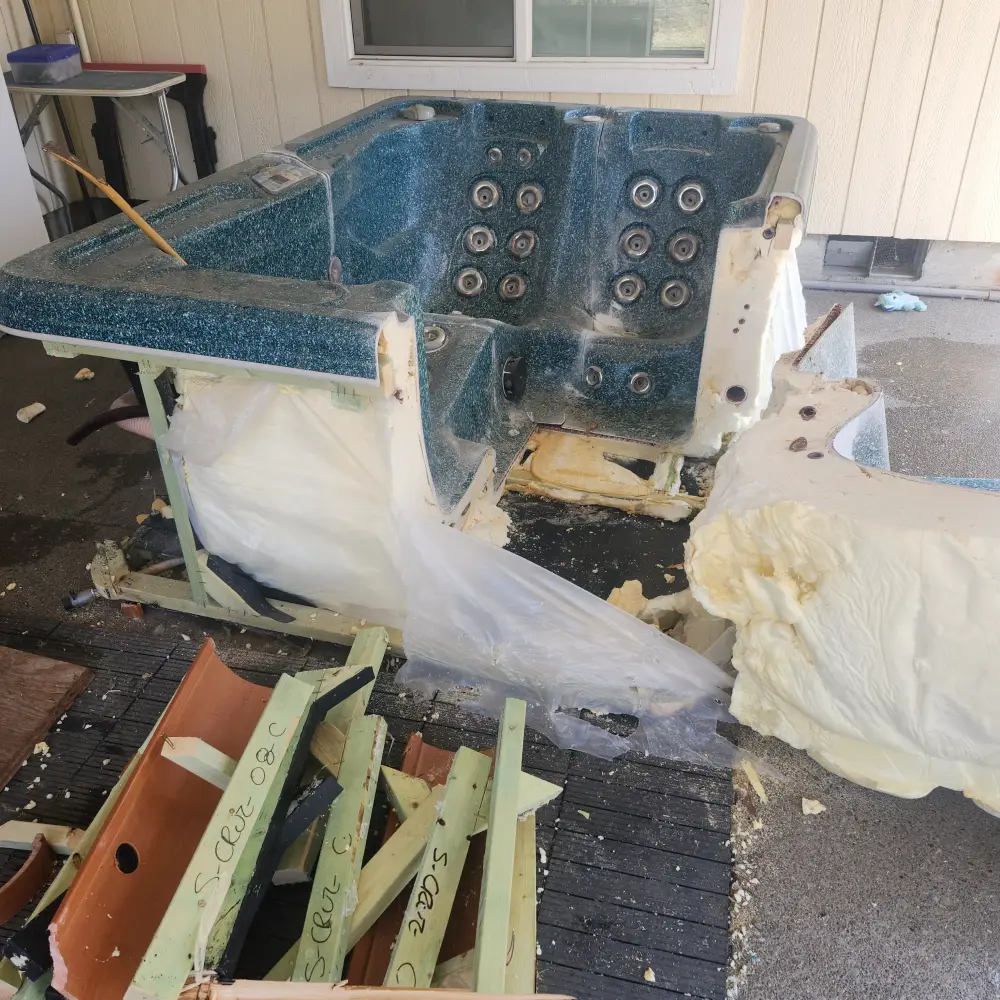
Drain it if you can; tell us if you can't, and we'll talk it through. A removal crew cuts the empty shell into sections to carry it out. See how a hot tub is cut down.
Rather not deal with it? We remove hot tubs from $349 — cut-down, haul-away and disposal included.
Get a hot tub removal quote ↗Where can you drain hot tub water? What 605 cities say
The short answer: it depends on your city, and the storm drain is the spot most often off-limits. We looked at the draining rule on every one of our city guides to see what US cities actually allow.
Method
We analysed the draining rules from city and state sources for 605 cities in our guides. Each city guide carries a source-checked "Draining" rule built from that city's code or stormwater page, and county or state guidance where the city defers to it, each with links. We read every rule and recorded what it says about three routes: the storm drain or street, the sanitary sewer (including household drains and sewer clean-outs), and your own lawn or landscaping. We were conservative. Where the city has no rule of its own, or its rule doesn't settle the question, we marked it unclear rather than guessing. Many rules are written for swimming pools and don't name spas; in 304 of the 605, the rule or the guidance it cites explicitly covers spas or hot tubs. The rules were reviewed in September and October 2026 and cover 19 states. This is a summary, not legal advice.
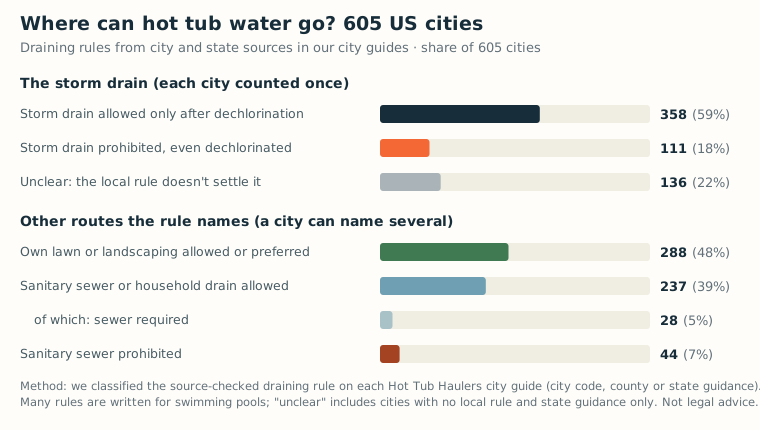
What the 605 cities say
| Category | Cities | Share | What it means |
|---|---|---|---|
| Storm drain allowed only after dechlorination | 358 | 59% | Clean, dechlorinated water may go to the street or storm drain, often with a chlorine limit, a pH range or a slow flow. Many of these still prefer the lawn or sewer. |
| Storm drain prohibited | 111 | 18% | Spa or pool water may not go to the storm drain or street at all, even dechlorinated. 22 of these require the sanitary sewer. |
| Unclear | 136 | 22% | No local rule, or the local rule doesn't settle where spa water may go. 41 of these rely on state guidance only. |
| Routes named (a city can name more than one) | |||
| Sanitary sewer / household drain allowed or required | 237 | 39% | Required in 28 cities; preferred or allowed in the rest, sometimes only with a permit or the sewer agency's OK. |
| Own lawn or landscaping allowed or preferred | 288 | 48% | Usually after dechlorination, slowly, and without running onto a neighbor's property. |
| Sanitary sewer prohibited | 44 | 7% | The city bars pool or spa water from the sewer, or allows it only with special approval. |
Where a rule names a chlorine limit (305 of the 605), the most common is "no detectable chlorine" (103 cities), then 0.1 mg/L (82), 1 ppm (51) and 0.01 mg/L (50). The most common pH range is 6.5 to 8.5 (102 cities).
State-by-state summary
Counts of cities in our guides. "Sewer" and "Lawn" count cities where that route is allowed, preferred or required.
| State | Cities | Storm drain after dechlorination | Storm drain prohibited | Unclear | Sewer | Lawn |
|---|---|---|---|---|---|---|
| California | 152 | 97 | 36 | 19 | 91 | 48 |
| Texas | 73 | 44 | 14 | 15 | 19 | 16 |
| Florida | 68 | 22 | 24 | 22 | 23 | 67 |
| Illinois | 30 | 16 | 3 | 11 | 4 | 8 |
| Arizona | 27 | 14 | 11 | 2 | 21 | 23 |
| Michigan | 25 | 16 | 3 | 6 | 1 | 25 |
| Washington | 24 | 22 | 0 | 2 | 21 | 11 |
| Minnesota | 22 | 10 | 4 | 8 | 3 | 15 |
| Ohio | 22 | 12 | 4 | 6 | 4 | 4 |
| Colorado | 20 | 7 | 2 | 11 | 5 | 3 |
| North Carolina | 19 | 14 | 2 | 3 | 3 | 18 |
| Virginia | 19 | 13 | 3 | 3 | 7 | 19 |
| Indiana | 18 | 13 | 2 | 3 | 1 | 2 |
| Maryland | 17 | 5 | 0 | 12 | 14 | 3 |
| Missouri | 16 | 14 | 0 | 2 | 3 | 2 |
| Tennessee | 16 | 14 | 0 | 2 | 3 | 3 |
| Georgia | 15 | 6 | 1 | 8 | 3 | 1 |
| Oregon | 11 | 9 | 2 | 0 | 11 | 9 |
| Wisconsin | 11 | 10 | 0 | 1 | 0 | 11 |
Patterns stand out. Florida's rules lean hard on the lawn (67 of 68 cities), following state DEP guidance to let chlorine drop to 0.01 mg/L or less and spread the water over grass. Washington cities almost all allow dechlorinated water to the storm drain at 0.1 ppm or less, while the state Department of Ecology says the sanitary sewer is "the best place" for pool or spa water. California has the most outright storm-drain bans (36 cities), many in Bay Area cities that require the sanitary sewer. Maryland, Colorado and Georgia have the highest share of unclear cities: their local codes often defer to state guidance or exempt only "pollutant-free" water without saying what that means for a spa.
Six real rules, quoted
- Garland, Texas: sewer only. The city's stormwater page says its ordinance requires owners of "pools, hot tubs, or spas to drain them into a sanitary sewer, not into grass, alleys, streets or storm drains." (Garland Stormwater)
- San Clemente, California: never the street. "Pool and spa drains must be plumbed to the sewer, not the street," and pool maintenance water is never allowed into the gutter, street or storm drain. The city recommends calling the sewage treatment plant at 949-366-1553 first. (City of San Clemente)
- Richmond, California: the sanitary drain, slowly. The city asks you to drain a spa to the sanitary drain and keep the flow to about 10 gallons per minute, "about the flow through a normal garden hose". (City of Richmond Wastewater)
- Burke, Virginia (Fairfax County): dechlorinate, test, lawn first. Let the water sit 7 to 10 days or use sodium thiosulfate, test for total residual chlorine or bromine below 0.1 mg/L and pH between 6.0 and 8.0, and drain over vegetated ground on your property where possible. The storm drain is the backup, at no more than 25 gallons per minute. Salt water goes to the sanitary sewer through a household drain. (Fairfax County)
- Milwaukee, Wisconsin: dechlorinated pool water is exempt. The city's storm water ordinance exempts swimming pool water once it has been dechlorinated. The Wisconsin DNR recommends letting the water sit at least 6 to 8 hours in direct sunlight, testing for a pH near 7, and draining over a well-vegetated area of your own property, not by hose straight into a storm sewer. (Milwaukee ch. 120; Wisconsin DNR)
- Novi, Michigan: a rule written for hot tubs. Novi's code lets hot tub water go to yard areas, paved surfaces or storm drains once it is neutralized, by letting it sit 7 to 10 days without adding chlorine or by using a dechlorinating additive. It may never be drained straight into a stream, or onto a neighbor's property without consent. (Novi Code § 12-28)
Find your own city's rule, with its sources, on our service areas page.
How to drain hot tub water safely and legally
Your city's rule comes first. Where it is silent, these steps follow the state guidance cited in our city guides.
- Stop adding chlorine or bromine, then let it fade. Waiting periods vary widely by agency. The Wisconsin DNR recommends letting pool water sit at least 6 to 8 hours in direct sunlight. The Minnesota Pollution Control Agency says chlorination must be stopped three days before discharge. Washington's Department of Ecology says a week or longer. Fairfax County says 7 to 10 days, or use a neutralizer such as sodium thiosulfate. Michigan EGLE, in the guidance cited on our Michigan city pages, says about two weeks uncovered in sunlight, or until testing shows no chlorine or bromine remains.
- Test it. Use a test strip or kit. Fairfax County's limit is total residual chlorine or bromine below 0.1 mg/L. Washington and many California rules use the same 0.1 mg/L line. Florida DEP guidance asks for 0.01 mg/L or less, after the water stands at least 48 hours since the last chlorine.
- Check the pH. Wisconsin DNR says near pH 7; Fairfax County says 6.0 to 8.0; several California programs say 6.5 to 8.5.
- Let it cool. Michigan EGLE guidance, cited on our Michigan pages, says water going to a storm sewer must be cooled first, and Auburn and Kirkland, Washington, ban heated water from their storm drains. Washington Ecology notes warm pool water can harm aquatic life.
- Drain slowly onto your own lawn where that's allowed, so it soaks in and doesn't run onto a neighbor's property or into the street. Washington Ecology suggests a spot that isn't covered with plants, because chlorine damages them.
- Use the sanitary sewer only where your city allows it, through a household drain or sewer clean-out. Wisconsin DNR says to check that your plumbing can take the flow, and that local rules may not let you open a manhole.
- Never send it to a septic system. Minnesota and Wisconsin both advise against it; septic systems may not handle the volume.
- Salt-water spas need their own route. Fairfax County sends salt water to the sanitary sewer through a household drain, never a storm drain. Michigan EGLE requires a permit before a saltwater tub drains to a storm sewer.
- Keep filter backwash and cleaning chemicals out of storm drains. Washington Ecology sends backwash to the sanitary sewer.
- Never into a storm drain where it's prohibited, dechlorinated or not.
This is general guidance, not legal advice. When your city's rule is unclear, call its stormwater or public works office before you drain.
Mistakes to avoid
- Draining with the breaker on. A pump or heater that runs dry can be damaged.
- Running the hose to the street because it's closest. In 111 of the cities we checked, that's prohibited even for dechlorinated water.
- Treating "no rule on the city's website" as permission. Our data marks 136 cities as unclear for exactly this reason.
- Draining onto a neighbor's yard. Many rules, including Kenosha's and Novi's, bar water running onto another property without consent.
- Draining fast down a slope, which causes erosion and runoff.
- Refilling over the rim, which can trap air in the pump.
Ready for the tub to go?
If you're draining because the tub is being removed, the hard part is next: cutting it down, carrying it out and disposing of it. See how to get rid of a hot tub and what hot tub removal costs, or check our pricing.
Rather not deal with it? We remove hot tubs from $349 — cut-down, haul-away and disposal included.
Get a hot tub removal quote ↗Frequently asked questions
How long does it take to drain a hot tub?
Jacuzzi says 30 to 90 minutes by gravity through the drain spigot for a 300–400 gallon spa, or about 10 to 15 minutes with a 2,000–3,000 GPH submersible pump. Divide your tub's gallons by the pump's gallons per hour and multiply by 60 for minutes.
How often should you drain a hot tub?
Jacuzzi says most acrylic spas should be drained every three to four months, or at least three times a year. Hot Spring says the water should last about four months, depending on how much soap gets into it.
Where can I drain my hot tub water?
Wherever your city allows. In the 605 cities in our guides, 358 allow dechlorinated water to the storm drain, 111 prohibit the storm drain entirely, 288 allow or prefer your own lawn and 237 allow the sanitary sewer. Check your city's rule first.
Can I drain my hot tub into the street or storm drain?
Only if your city allows it, and almost always only after the water is dechlorinated. 111 of the 605 cities we checked, including Garland, Texas and San Clemente, California, prohibit it even then.
Do I need to turn off the power to drain a hot tub?
Yes. Turn the spa off at its breaker before draining. Hot Spring's manual says to disconnect power before draining, and Jacuzzi warns that running pumps or heaters dry, even briefly, can damage them.
Should I drain my hot tub before it's removed?
Yes, drain it fully if you can, and tell your removal company if you can't. Water weighs about 8.34 pounds per gallon, so a full tub is far too heavy to cut down or move.
Sources
- Jacuzzi: How to Drain a Spa, Step-by-Step Guide
- Hot Spring Spas: Hot Spot Collection SX/TX Owner's Manual (PDF)
- Wayne Pumps: TSC130 1/4 HP submersible utility pump
- Wisconsin DNR: Best Management Practices for the Disposal of Residential Swimming Pool Water (PDF)
- Minnesota Pollution Control Agency: Swimming Pool and Hot Tub Water Discharges BMPs (PDF)
- Washington Department of Ecology: Do's and Don'ts of Draining your Pool (PDF)
- Florida DEP: Stormwater Pollution Prevention BMP, swimming pool discharges (PDF)
- Michigan EGLE: Disposal of residential wastewater such as swimming pool water
- Fairfax County: Proper Discharge of Swimming Pool Water
- City of Garland: Stormwater, Swimming Pools
- City of San Clemente: Ocean Water Quality
- City of Richmond Wastewater: Households
- Milwaukee Code of Ordinances ch. 120: Storm Water Management Regulations (PDF)
- Novi Code § 12-28: Discharge of swimming pool and hot tub water
- USGS Water Science School: A million gallons of water, how much is it? (8.34 lb per gallon)
- Hot Tub Haulers city guides: draining rules for 605 US cities, reviewed September–October 2026