Short answer: don't, unless your local health department tells you otherwise. Most health departments, extension services and state agencies say hot tub water shouldn't go into a septic system. One state agency is less strict about hot tubs than pools, and we cover that below. The safer route is almost always your lawn, dechlorinated and slowly, well away from the drainfield.
Key takeaways
- Two problems: volume and chemistry. A spa dumps hundreds of gallons at once, which can push solids into the drainfield and flood it. Chlorine and bromine can harm the bacteria that treat your wastewater.
- The numbers: common spas hold about 190–455 gallons (manufacturer specs). Iowa's minimum septic tank for a home with up to three bedrooms is 1,250 gallons.
- Sources mostly agree. King County, Wisconsin DNR, Washington Ecology, two university extensions and several city and county rules say no. Minnesota's MPCA says no for pools, but treats hot tubs as "less of a problem".
- Better options: dechlorinate, then drain slowly onto your own lawn away from the drainfield and well, where your local rules allow, or have the water hauled.
- 41 of the 605 city rules in our guides mention septic systems. None of them tells you to drain a hot tub into one.
Why draining a hot tub into a septic system is a problem
A septic system is a small treatment plant buried in your yard. EPA describes it in two parts. The tank holds wastewater long enough for solids to settle into sludge at the bottom while grease floats to the top as scum. The liquid in the middle, the effluent, then flows out to the drainfield, where it filters through the soil. Living organisms in the system do the treating.
A hot tub drain hits both parts at once.
1. Hydraulic overload: too much water, too fast
Septic systems are sized for a household's daily flow, not a sudden flood. EPA's own advice is to spread water use out: it says to "spread washing machine use throughout the week", because doing all the laundry in one day can harm the system. It also says to keep roof drains and sump pumps away from the drainfield, because "excess water slows down or stops the wastewater treatment process." A full spa is all of that at once.
What can go wrong:
- Solids get flushed out. The Minnesota Pollution Control Agency (MPCA) says the large volume of pool water "can reduce treatment efficiency" and can "flush solids into the drain field" or "create a surface outbreak of sewage".
- The drainfield floods. EPA says that if the drainfield is overloaded with too much liquid, it can flood, sending sewage to the ground surface or backing up into toilets and sinks. King County, Washington puts it plainly: large volumes of water can "drown" your drainfield.
- The system may fail. Wisconsin DNR says septic systems "may not be able to handle the flow from the pool and may fail", and recommends checking with a licensed plumber before considering it.
2. Chemistry: sanitizer and septic bacteria
EPA says your septic system "contains a collection of living organisms that digest and treat household waste" and that "pouring toxins down your drain can kill these organisms." King County says chlorine "can destroy important bacteria in your septic tank and drainfield." The University of Arizona Cooperative Extension tells homeowners to divert chlorine-treated water from swimming pools and hot tubs outside of the septic system.
Hot tub water isn't lightly treated. North Carolina's health department gives routine hot tub levels of 3–10 ppm free chlorine or 4–8 ppm bromine. Draining it untreated sends that sanitizer straight into the tank. Dechlorinating first helps the chemistry, but it does nothing for the volume.
Spa volume vs. septic tank volume
Here's how real spas compare with real minimum tank sizes. Spa gallons come from the manufacturer specs in our hot tub weight guide. Tank sizes come from state code: Iowa requires at least 1,250 gallons for homes with up to three bedrooms, and Pennsylvania's minimum for any installation is 900 gallons.
| Spa (manufacturer spec) | Gallons | Share of a 1,250-gal tank (Iowa, up to 3 bedrooms) | Share of a 900-gal tank (Pennsylvania minimum) |
|---|---|---|---|
| Hot Spring Hot Spot TX (2 seats) | 190 | 15% | 21% |
| Jacuzzi J-335 (5–6 seats, average) | 350 | 28% | 39% |
| Hot Spring Grandee (7 seats) | 455 | 36% | 51% |
| Master Spas Michael Phelps Signature PRO (swim spa) | 2,445 | 196% | 272% |
Compare that with normal use. Iowa sizes systems on 150 gallons per bedroom per day, or 450 gallons a day for three bedrooms, and EPA says indoor use can reach 70 gallons per person per day. Jacuzzi says a 2,000–3,000 GPH pump empties a 300–400 gallon spa in 10 to 15 minutes. That's close to a whole day's design flow arriving at once. A swim spa holds about twice what a typical minimum tank does.
Where the sources disagree
Most of what we read says the same thing. The exception is Minnesota.
- Firm no: King County Public Health ("Don't drain water from hot tubs into your septic system"). Bloomfield Township, Michigan's septic brochure says draining a hot tub into the septic system "or over the drain field can overload the system." University of Maryland Extension says to direct hot tub water away from the tank and drainfield.
- Strongly discouraged: Wisconsin DNR "strongly recommends" that pool water not be drained into a septic system. Washington Ecology says most septic systems can't handle the volume of a swimming pool.
- Softer, for hot tubs only: MPCA's guidance says swimming pools should never go to an individual sewage treatment system. For hot tubs, it says the smaller volumes make discharge "less of a problem", and notes that hot tubs are often plumbed to a home's septic or the city sewer. Even so, it says chlorine must be minimized first. With tight or highly impermeable soils, or an undersized or poorly maintained system, it says to spread the water on the soil away from the system instead.
So a small, dechlorinated tub on a large, healthy system is less risky than a big tub on a small one. But you probably don't know your soil or how full your tank is, and a failed drainfield costs far more than a few extra hours with a hose. When in doubt, keep it out of the septic system. If your hot tub is already plumbed into a septic system, ask your county health department or a licensed septic professional before using that connection.
Rather not deal with it? We remove hot tubs from $349 — cut-down, haul-away and disposal included.
Get a hot tub removal quote ↗What to do instead: options on a septic property
Option 1: dechlorinate, then drain onto your own lawn
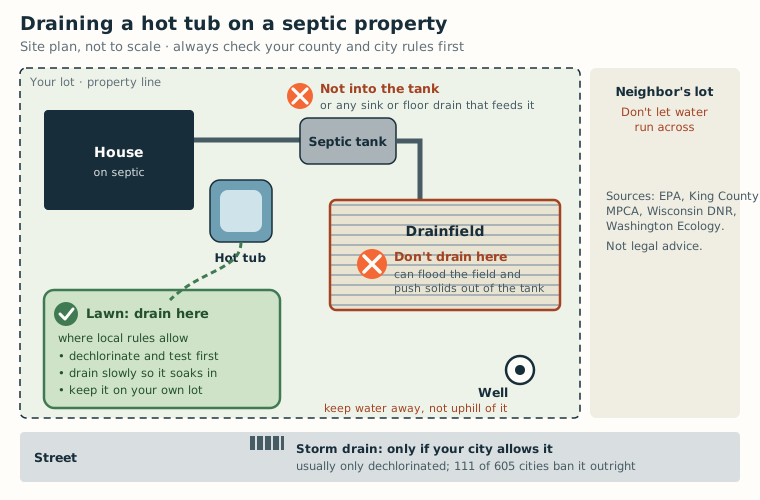
This is the route most agencies point septic owners to. Washington Ecology says that if you have a septic system, the yard "is your best choice". MPCA recommends discharging chlorine-free water to a vegetated surface so it soaks in. How to do it:
- Dechlorinate first. Stop adding sanitizer and let it fade, or neutralize it, then test. Waiting times vary by agency: MPCA says stop chlorinating three days before, Washington Ecology says a week or longer. See how to dechlorinate hot tub water for methods and test limits.
- Pick a spot away from the drainfield and tank. Bloomfield Township warns against draining over the drain field, and King County says to drain away from the system, especially the drainfield. Don't let the water run back toward it.
- Keep it away from your well. We didn't find an agency setback specific to spa water and private wells. As general guidance, run the water to an area well away from, and not uphill of, your wellhead. Washington Ecology notes that pool water can affect drinking water supplies.
- Drain slowly. Use the drain spigot and a garden hose, or throttle a pump, so the water soaks in instead of pooling or running off. Move the hose if the ground gets soggy.
- Keep it on your property. MPCA says the discharge shouldn't flow onto anyone else's property. Washington Ecology says to make sure it doesn't run into a storm drain either. It also suggests a spot not covered with plants, because chlorine damages them.
For the full draining steps, from breaker off to the last inch of water, see how to drain a hot tub.
Option 2: have the water hauled
Where your lot can't absorb it (tight soils, a small yard, a steep slope toward the drainfield), the water can be pumped out and taken to the sewer. Bellevue, Washington lists hiring a draining service that takes the water to the sewer as one of its four legal ways to drain a hot tub.
Option 3: the storm drain, only if your city allows it
Being on septic doesn't change the street rules. In the 605 cities in our guides, 358 allow dechlorinated water to the storm drain and 111 prohibit it even when dechlorinated. Check your city first, or see hot tub draining rules by state.
If you're removing the tub
Drain it if you can; tell us if you can't, and we'll talk it through. A tub has to be empty before it can be cut down and carried out.
What the city rules say about septic systems
We read the source-checked draining rule on each of our 605 city guides. 41 of them mention septic systems, in 11 states. Not one says to drain a hot tub into one. Examples:
- Surprise, Arizona: the city prefers draining onto rocks or desert landscaping on your lot, or pumping into your sewer clean-out at no more than 12 gallons per minute, and says never drain into a septic system.
- Mansfield, Texas: dechlorinate to 0.5 ppm or less, then use the sanitary sewer clean-out or let it soak slowly into your lawn. Never the street, a storm drain or a septic system.
- Petaluma, California: Sonoma County's guide says that on a septic system you shouldn't drain into the tank, and should release only clear, dechlorinated water onto plants on your own property.
- Aurora, Illinois: Kane County's guidance covers hot tubs: dechlorinate, then drain across your lawn, not down the driveway, into a storm drain, onto someone else's property or into a septic system.
- Mentor, Ohio: the Lake County General Health District says homes not on the sanitary sewer can drain dechlorinated water onto their own lawn, and that septic systems should not take it.
- Mableton, Georgia: Cobb County Water System says never drain pool or spa water to a street, storm drain, ditch, creek, pond or septic system. Dechlorinate to 0.1 mg/L and drain slowly onto your lawn.
In Michigan, the state's EGLE guidance, as summarized on 13 of our Michigan city pages such as Livonia, says the same: drain hot tub water onto the ground, not into a septic system, and keep it on your property.
Mistakes to avoid
- Pulling the drain into a floor drain or laundry sink without knowing whether it goes to the septic tank.
- Draining onto the drainfield because "it's just water". The drainfield is the part most easily flooded.
- Draining before dechlorinating. Sanitizer harms plants, soil life and septic bacteria.
- Pumping fast onto a slope that runs toward the drainfield, the well, a neighbor or the street.
- Assuming no rule means anything goes. Ask your county health department if you're unsure.
This is general guidance, not legal advice. Your county health department and city stormwater office have the final word.
Done with the tub altogether?
If you're draining because the tub is going, the hard part comes next: cutting it down, carrying it out and disposing of it. See how to get rid of a hot tub and our pricing.
Rather not deal with it? We remove hot tubs from $349 — cut-down, haul-away and disposal included.
Get a hot tub removal quote ↗Frequently asked questions
Can I drain my hot tub into my septic tank?
It's generally advised against. King County, Washington says not to, because large volumes of water can 'drown' the drainfield and chlorine can destroy the bacteria the system relies on. Minnesota's pollution agency is softer for hot tubs but still says to drain onto the soil away from the system when soils are tight or the system is small or poorly maintained.
Can I drain my hot tub on my lawn if I have a septic system?
Usually that's the recommended route, where your local rules allow it. Washington's Department of Ecology says the yard is the best choice for homes on septic. Dechlorinate first, drain slowly, keep it off the drainfield and away from your well, and don't let it run onto a neighbor's property or into a storm drain.
How much water is in a hot tub compared to a septic tank?
Manufacturer specs put common spas at about 190 to 455 gallons. Iowa's code sets a 1,250-gallon minimum tank for homes up to three bedrooms, so a large spa equals about a third of that tank, emptied in minutes.
Will chlorine from a hot tub kill my septic system?
It can harm it. EPA says pouring toxins down the drain can kill the organisms that treat household waste, and King County names chlorine specifically. Hot tubs run at 3–10 ppm free chlorine in normal use, per North Carolina's health department, so dechlorinate before draining anywhere.
Can I drain my hot tub into the street if I'm on septic?
Only if your city allows it, and usually only after dechlorination. In the 605 cities in our guides, 111 bar spa or pool water from the storm drain even when it's dechlorinated. Check your city's rule first.
Sources
- US EPA: How Your Septic System Works
- US EPA: How to Care for Your Septic System
- US EPA: SepticSmart
- King County Public Health (WA): About septic systems
- Minnesota Pollution Control Agency: Swimming Pool and Hot Tub Water Discharges BMPs (PDF)
- Wisconsin DNR: Best Management Practices for the Disposal of Residential Swimming Pool Water (PDF)
- Washington Department of Ecology: Do's and Don'ts of Draining your Pool (PDF)
- University of Arizona Cooperative Extension: Septic system care, AZ1258 (PDF)
- University of Maryland Extension: Homeowner Septic System Guide and Record Folder (PDF)
- Bloomfield Township, MI: A homeowner's guide to septic systems (PDF)
- NC DHHS: Guidance for hot tubs in private, rental and vacation homes (PDF)
- Iowa Admin. Code r. 567-69.8: Primary treatment, septic tanks
- 25 Pa. Code § 73.31: Standards for septic tanks
- Hot Spring Hot Spot TX specifications
- Jacuzzi J-335 hot tub review (specifications)
- Hot Spring Grandee specifications
- Master Spas Michael Phelps Signature swim spas
- Jacuzzi: How to Drain a Spa, Step-by-Step Guide
- Michigan EGLE: Disposal of residential wastewater such as swimming pool water
- City of Surprise, AZ: Draining your pool or spa the right way (PDF)
- Mansfield, TX: How to Drain Your Swimming Pool
- Sonoma County: Guidelines for Proper Disposal of Swimming Pool, Spa & Filter Backwash Water (PDF)
- Kane County, IL: Guidelines for Draining Swimming Pools (PDF)
- Lake County (OH) General Health District: Where Do I Drain My Pool? (PDF)
- Cobb County Water System: Residential Pool & Spa
- City of Bellevue Utilities: Draining Pools, Hot Tubs and Water Features
- Hot Tub Haulers city guides: draining rules for 605 US cities, reviewed September–October 2026