In most places, hot tub water has to be dechlorinated before it goes onto a lawn or into a storm drain. This guide covers the two ways to do it, how to prove it worked, and what to do with the chemicals you have left. For where the water can go once it's ready, see how to drain a hot tub, which has our study of 605 cities' draining rules.
Key takeaways
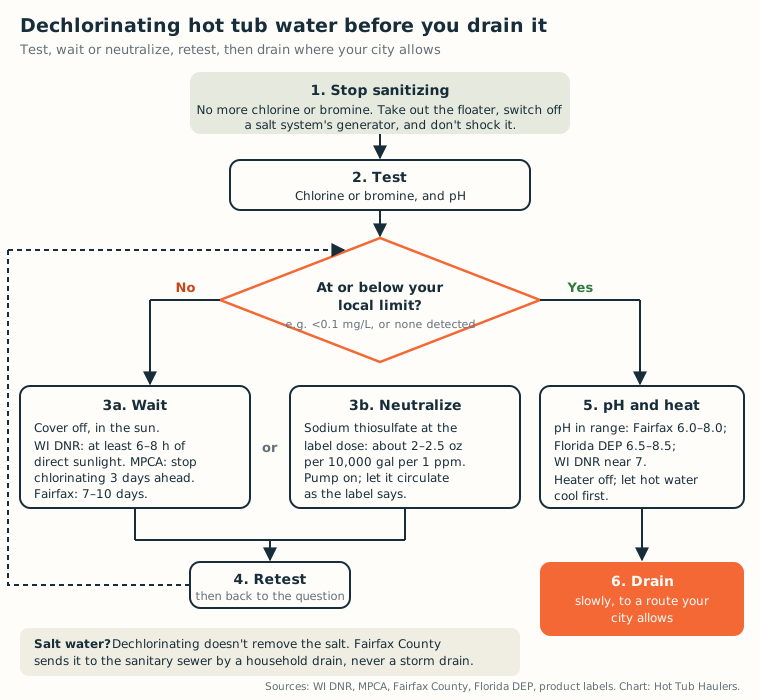
- Stop adding sanitizer first. Then wait for it to fade, or neutralize it with sodium thiosulfate.
- Waiting periods vary from 6 to 8 hours of direct sun (Wisconsin DNR) to 7 to 10 days (Fairfax County).
- Neutralizer labels we checked call for 2 to 2.5 ounces per 10,000 gallons per 1 ppm. A spa needs very little.
- Test to your local limit. Common ones are below 0.1 mg/L, 0.01 mg/L or "no detectable" chlorine. Check the pH too.
- Dechlorinated doesn't mean storm-drain approved. 111 of the 605 cities we checked ban spa or pool water from storm drains even when it's dechlorinated.
Why dechlorinate hot tub water before draining
Storm drains often flow to streams or lakes, as Washington's Department of Ecology puts it. Chlorine that's safe for people in a spa isn't safe for fish. Florida DEP says "Even at low levels, chlorine can be toxic to aquatic life," and Florida law limits chlorine discharged to surface waters to 0.01 mg/L or less. Washington Ecology says chlorine damages fish gills. Bromine, the other common spa sanitizer, is no better: one EPA-registered bromine spa product's label says "This pesticide is toxic to fish."
That's why most city rules hinge on dechlorination. Of the 605 cities in our draining study:
- 358 (59%) allow spa or pool water to the storm drain only after it's dechlorinated, often with a chlorine limit, a pH range or a slow flow.
- 111 (18%) ban it from the storm drain even when dechlorinated. Stockton, California is one: its code keeps pool water out of the storm drain system even dechlorinated.
- 305 name a chlorine limit. The most common are "no detectable chlorine" (103 cities), 0.1 mg/L (82), 1 ppm (51) and 0.01 mg/L (50).
So dechlorinating is the price of entry for the lawn or the street, not a free pass. Check your city's rule on our service areas page.
How long does chlorine take to leave hot tub water?
There's no single answer, because agencies give very different waiting periods. Here's what the guidance says, and what the 180 cities in our study that name a waiting period ask for.
| Source | Waiting period |
|---|---|
| Wisconsin DNR | At least 6 to 8 hours in direct sunlight, in water 7 feet deep or less |
| Florida DEP | At least 48 hours after the last chlorine, or until free chlorine is 0.01 mg/L or less |
| Minnesota Pollution Control Agency | Stop chlorinating three days before discharge; in most instances three to four days |
| Washington Ecology | A week or longer |
| Fairfax County, VA | 7 to 10 days, or use sodium thiosulfate |
| Waiting period named in a city's rule | Cities | Mostly from |
|---|---|---|
| Hours (6 to 8 hours, or 12) | 7 | Wisconsin DNR guidance |
| 1 to 3 days | 74 | Florida DEP's 48 hours; Ohio and Minnesota rules |
| 4 to 7 days | 44 | "A week" in many state and city rules |
| 10 days to 2 weeks | 44 | Michigan's "about two weeks"; Fairfax County's 7 to 10 days |
| "A few" or "several" days | 11 | Various |
Method: from the 605 city draining rules in our study, we took the 180 that name a waiting period and grouped them by the shortest period each names. Many cities repeat their state's guidance, so states drive the counts.
Your sanitizer's label may have its own rule. One EPA-registered pool chlorine label says chlorine "must be allowed to dissipate" before water is drained and not to chlorinate within 24 hours before discharge.
Method 1: let it sit with the cover off
This is the free option, and it works for most people with a few days to spare.
- Stop adding chlorine or bromine. Take out any floater or cartridge feeder and switch off a salt system's generator.
- Don't shock it. Shock raises sanitizer levels. One bromine tablet label has spa owners superoxidize to 10 to 20 ppm of available bromine, the opposite of what you want before a drain.
- Leave the cover off in the sun. Wisconsin DNR's 6-to-8-hour guidance assumes direct sunlight. A covered or shaded tub will take longer.
- Test once a day until you're under your local limit.
Leave yourself time. If a removal is booked, start a few days ahead.
Method 2: neutralize it with sodium thiosulfate
If you can't wait, a chlorine neutralizer does it chemically. Fairfax County and Florida DEP both name sodium thiosulfate, sold at pool stores. This is the fast way to lower chlorine in a hot tub.
| Source | Sodium thiosulfate to lower 1 ppm in 10,000 gallons |
|---|---|
| Haviland Chlor Out label (90–100% sodium thiosulfate) | 2.5 oz, for chlorine or bromine |
| Regal Chlorine and Bromine Neutralizer label (100% sodium thiosulfate) | 2 oz, for chlorine or bromine |
| Indiana Department of Health dosing table | 2.6 oz |
| Yakima County dosing chart | 1.0 oz |
The figures differ by product and formulation. Both agencies say to follow the manufacturer's label for exact amounts, so do that.
Working out a dose for a hot tub
Indiana's method: multiply the label amount by the ppm you need to remove, then by your volume divided by 10,000 gallons. For a 400-gallon spa reading 3 ppm, with a 2.5 oz label: 2.5 × 3 × (400 ÷ 10,000) = 0.3 oz. That's about a third of an ounce. Spas are small, so it's easy to overshoot. Start at the label dose for your reading and retest before adding more.
Adding it
- Test first, so you know how many ppm you're removing.
- Dissolve it in a bucket of spa water if your label says to. The Regal label does; CDC says to pre-dissolve pool chemicals only when the label directs.
- Add it with the pump running, as the Regal label directs, and let it circulate. Regal says 30 minutes to 1 hour.
- Retest. Repeat only if you're still over the limit.
Rather not deal with it? We remove hot tubs from $349 — cut-down, haul-away and disposal included.
Get a hot tub removal quote ↗Bromine hot tubs: what's different when draining
Bromine is common in spas, and it doesn't fade the way chlorine does. Washington Ecology says bromine "does not break down over time like chlorine does," and in high doses causes many of the same effects to fish. So waiting alone is slower and less certain with bromine.
- Rules cover it. Fairfax County's limit is total residual chlorine or total residual bromine below 0.1 mg/L, and it says to let chlorine or bromine dissipate for 7 to 10 days or use a neutralizer.
- The same neutralizers work. Both labels above are for chlorine or bromine, at the same dose.
- Test for bromine. Use a strip or kit that reads bromine, not just chlorine.
- Pull the bromine source first. Take out the floater or feeder and don't shock.
Salt-water hot tubs
A salt-water spa is still a chlorine spa. Master Spas explains that the generator "converts the salt into chlorine through a process called electrolysis," with typical salt levels of 2,000 to 3,000 ppm. Switch the generator off before you start, or it will keep making chlorine.
Dechlorinating removes the chlorine, not the salt. Fairfax County says salt water "should not be discharged to a storm drain or stream" and should go to the sanitary sewer through a household drain such as a bathtub, sink or floor drain. It adds that residents may not open a manhole cover to drain pool water. Check your own city's rule before draining a salt tub anywhere else.
Testing: what counts as dechlorinated
Test for whatever your rule names, then check the pH. Target levels by source:
| Rule | Chlorine or bromine | pH |
|---|---|---|
| Fairfax County, VA (e.g. Burke) | Total residual chlorine or bromine below 0.1 mg/L | 6.0 to 8.0 |
| Florida DEP (e.g. Tallahassee) | Free chlorine 0.01 mg/L or less; none should be detected | 6.5 to 8.5 |
| Wisconsin DNR (e.g. Milwaukee) | Let it dissipate to appropriate levels | Near 7 |
| Most common in our 605 cities | "No detectable chlorine" (103 cities) | 6.5 to 8.5 (102 cities) |
- Units. For water, ppm and mg/L are used interchangeably; Indiana's health department writes "ppm (mg/l)."
- Free or total? Florida's guidance names free chlorine. Fairfax names total residual chlorine. Many strips read both, so check the one your rule uses.
- Know your test's limit. Home tests aren't lab instruments. Taylor's K-2006 drop kit reads chlorine in steps of 0.2 or 0.5 ppm per drop, from 0.2 ppm up. That can't show the difference between 0.1 and 0.01 mg/L. Where a rule says 0.01 mg/L or "no detectable," a test that reads zero is the most a homeowner can show, so give it extra time or a neutralizer dose before draining.
- Fix the pH. Washington Ecology says aquatic life does best between pH 7 and 8 and that sudden pH shifts can injure fish.
- Let it cool. Washington Ecology also warns that warm pool water can harm aquatic life. Turn the heater off at the breaker before you drain.
Then drain slowly. Fairfax recommends 12 to 15 gallons a minute, with 25 the maximum to a storm drain or stream.
Disposing of leftover hot tub chemicals
If the tub is going away, so are the chemicals. They count as household hazardous waste: EPA defines it as leftover household products that can catch fire, react or explode under certain circumstances, or that are corrosive or toxic. San Joaquin County says the most common pool chemicals "are highly reactive and/or corrosive."
- Don't dump them. EPA warns against pouring household hazardous waste down the drain, on the ground or into storm sewers, or in some cases putting it in the regular trash.
- Keep them in their original, labeled containers, as EPA advises, and never in food containers.
- Never mix them. EPA says incompatible products might react, ignite or explode. San Joaquin County warns oxidizers will release poisonous chlorine gas if they contact acids, so store and carry chlorine and pH-down apart.
- Use them up or give them away if they're still good. San Joaquin County suggests both before disposal.
- Take the rest to a household hazardous waste collection. Examples from our city guides: Mesa, AZ takes pool chemicals from residents at its Household Hazardous Materials facility; Grand Junction, CO residents can use Mesa County's facility, which lists spa and pool chemicals; Lakeville, MN residents can use Dakota County's Recycling Zone; and Stockton, CA residents can use San Joaquin County's facility.
- Don't leave them in the tub. Take chemicals out of the cabinet and steps before a removal so they don't travel with the shell.
Safety
- Read and follow the label on every product. CDC says to wear safety equipment such as goggles and masks as directed.
- Add chemicals to water, never water to chemicals, as CDC advises.
- Never mix pool chemicals with each other, especially chlorine products with acid.
- Keep children and pets away while you handle and store them.
- Turn the spa off at the breaker before draining, and leave any electrical disconnection to a licensed electrician.
- Drain only where your local rules allow. This guide is general guidance, not legal advice.
Draining because the tub is going?
Dechlorinate it, drain it if you can, and have a licensed electrician disconnect it before removal day. Tell us if you can't drain it and we'll talk it through. We cut the tub down, carry it out, haul it away and dispose of it, from $349. Send photos for a quote, or see pricing.
Rather not deal with it? We remove hot tubs from $349 — cut-down, haul-away and disposal included.
Get a hot tub removal quote ↗Frequently asked questions
How long does it take for chlorine to leave hot tub water?
It depends on the sun and whose guidance you follow. Wisconsin DNR says at least 6 to 8 hours in direct sunlight, Florida DEP at least 48 hours after the last chlorine, Minnesota stops chlorination three days ahead, and Fairfax County says 7 to 10 days. Test rather than guess.
How much sodium thiosulfate do I need to dechlorinate a hot tub?
Follow your product's label. Two neutralizer labels we checked say 2 and 2.5 ounces per 10,000 gallons to lower chlorine or bromine by 1 ppm. For a 400-gallon spa reading 3 ppm, that's about a third of an ounce or less.
Can I drain hot tub water on my lawn?
In many places, once it's dechlorinated, drained slowly and kept on your own property. Florida DEP and Wisconsin DNR both point to vegetated ground. Some cities require the sanitary sewer instead, so check your city's rule first.
Do I need to neutralize bromine before draining a hot tub?
Yes, where your rule limits it. Fairfax County's limit covers total residual bromine below 0.1 mg/L, and Washington Ecology notes bromine doesn't break down over time like chlorine does. Sodium thiosulfate neutralizers are labeled for bromine too.
How do I dispose of old hot tub chemicals?
Use them up, give them to someone who will, or take them to a household hazardous waste collection. Don't pour them down a drain, onto the ground or into a storm sewer, and never mix them.
Sources
- Fairfax County: Proper Discharge of Swimming Pool Water
- Florida DEP: Stormwater Pollution Prevention BMP, swimming pool discharges (PDF)
- Wisconsin DNR: Best Management Practices for the Disposal of Residential Swimming Pool Water (PDF)
- Minnesota Pollution Control Agency: Swimming Pool and Hot Tub Water Discharges BMPs (PDF)
- Washington Department of Ecology: Do's and Don'ts of Draining your Pool (PDF)
- Indiana Department of Health: Adjusting Chemical Levels in a Swimming Pool (PDF)
- Yakima County: Dosages Required to Chemically Treat 10,000 Gallons of Water (PDF)
- Haviland Chlor Out chlorine neutralizer: product label directions
- Regal Chlorine and Bromine Neutralizer: product label directions
- US EPA pesticide label: Dantobrom S brominating tablets for spas, hot tubs and pools, EPA Reg. No. 6836-116 (PDF)
- US EPA pesticide label: sodium hypochlorite pool sanitizer, EPA Reg. No. 1744-20003 (PDF)
- Master Spas: Saltwater hot tub FAQs
- Taylor K-2006 FAS-DPD test kit specifications (Sunplay)
- US EPA: Household Hazardous Waste (HHW)
- San Joaquin County: Got Pool Chemicals?
- CDC: Thousands sent to emergency room by preventable pool chemical injuries (2014)
- Hot Tub Haulers city guides: draining rules for 605 US cities, reviewed September–October 2026