A hot tub on a deck comes out the same way as one on a patio, with three extra problems: the deck has to survive the job, the pieces have to get down the stairs, and once the tub is gone you have to deal with whatever it was hiding. This guide covers all three. For the general removal steps, see how to remove a hot tub.
Key takeaways
- Decks are built for 40 lb per square foot. A filled spa needs far more, so a spa deck was either built for it or has been carrying more than it should. Read how much a hot tub weighs.
- Off a raised deck, cutting the drained shell into sections and carrying them out is usually safer than lifting the whole tub.
- A deck-sunk or in-ground spa may need a demolition permit. Rules differ city to city.
- Afterward, check under the footprint for rot, loose fasteners and cut framing before anyone re-decks it or puts something new there.
Hot tub on a deck: why it's a different job
The International Residential Code sets a minimum live load of 40 pounds per square foot for decks (Table R301.5). The American Wood Council's deck guide, DCA 6, sizes its joists, beams and footings "based primarily on a uniformly distributed floor live load of 40 psf and a dead load of 10 psf." A filled spa concentrates far more than that. Hot Spring's Highlife pre-delivery instructions ask for a reinforced concrete pad at least 4 inches thick, or a deck able to withstand more than 115 to 130 pounds per square foot depending on the model. Our hot tub weight guide has the filled weights and per-square-foot loads from 12 spec sheets.
DCA 6 is blunt about it. Its Minimum Requirements say "Decks supporting large concentrated loads such as hot tubs are beyond the scope of this document," and its commentary repeats that hot tubs, stairs and planters are outside it. So a deck that carries a spa should have been designed by someone for that load. Many weren't. That matters on removal day in two ways:
- Draining takes most of the load off. The water is the heaviest part of a filled tub, so drain it first, before anyone works around it. See how to drain a hot tub, and how to dechlorinate the water first if it's headed for a lawn or storm drain.
- Years of load and water may have weakened the framing. The wood under and around a spa stays damp. Treat the boards around and under the tub as suspect until someone has checked them.
How to remove a hot tub from a deck
The order matters more than the tools.
- Power off at the breaker, then a licensed electrician disconnects it. The electrician makes the circuit safe before anyone opens a panel or cuts. See hot tub disconnect and whether that work needs a permit.
- Drain it completely. Follow your city's rule for where the water goes. Vacuum out the footwell.
- Strip the extras. Cover, cover lifter, steps and any accessories come off first. That gives you room to work and less weight on the deck.
- Protect the deck. Lay plywood or heavy mats along the carry route and around the tub, as described below.
- Cut the shell into sections on the deck. Panels off, equipment out, then the shell in pieces that two people can carry. Our cut-down page shows how.
- Carry the pieces down, one at a time. Check the stairs first. Never stack heavy sections on one spot of the deck while you work.
- Clean up and inspect. Sweep up foam and fiberglass, pull out stray screws, then look closely at the boards where the tub sat.
Cut it down on the deck, or lift it off whole?
| Method | When it fits | Watch out for |
|---|---|---|
| Cut down on the deck and carry out | Most removals. The tub is going to disposal, not being kept. | Saw dust and debris on the boards; blade depth; enough people to carry each piece. |
| Whole tub on a spa dolly, tipped on its side | A working tub being moved or sold, with a wide, level route and a ground-level deck. | Hundreds of pounds even empty. Stairs and narrow gates often rule it out. See how to move a hot tub. |
| Crane | A whole tub that has to go over a house, wall or railing; rooftop or high balcony tubs. | Cost, a licensed operator, and possibly a city permit for a crane on the street. |
Hot Spring's pre-delivery instructions say that "About ten percent of the time, a crane is the only way to install the spa," when the spa has to come off its cart to go over a wall because the entry is too narrow, the eaves too low, the corner too tight or the stairway too steep. That's for installing a whole spa. A tub headed for disposal doesn't need to stay in one piece, so it can be cut down and carried out instead. Rooftop and balcony tubs are the exception; see our page on awkward removals.
Protecting the deck boards
- Cover the route with plywood to spread each load across several boards and catch debris.
- Set the saw depth. Cut the shell, not the deck. Lift or prop sections before cutting through the base.
- Don't drag. Cut edges gouge decking. Carry pieces instead.
- Watch soft spots. Keep weight off any board that flexes or feels spongy.
Deck stairs
Stairs are where deck removals go wrong. NADRA's deck checklist says to make sure handrails are firmly held in place and that risers and stringers are securely attached and not decayed, and to keep stair paths clear of planters, décor and other tripping hazards. Check all of that before the first piece goes down. Size the pieces so each carry is easy, use enough people on every load, and never carry a section that blocks your view of the steps. If the stairs are steep or soft, pass pieces over the side to someone on the ground instead.
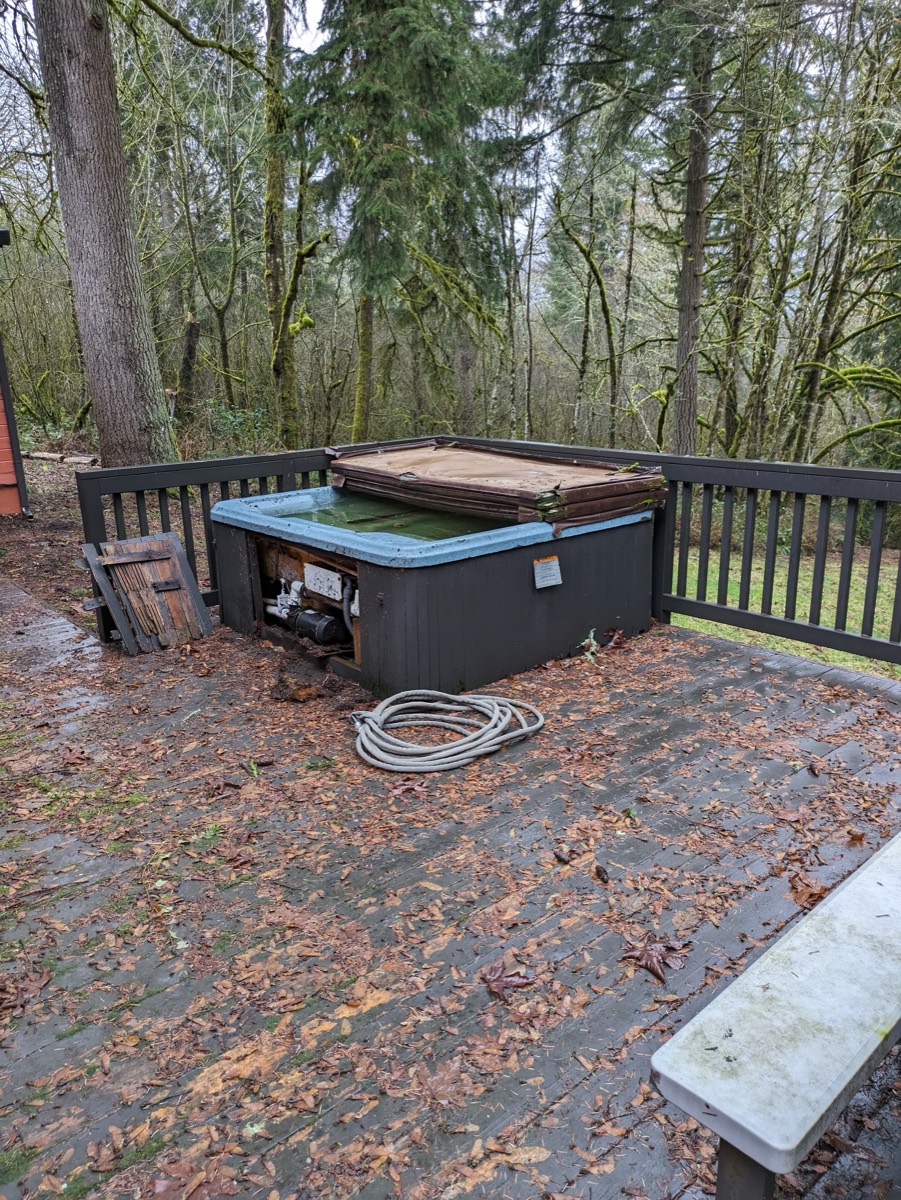
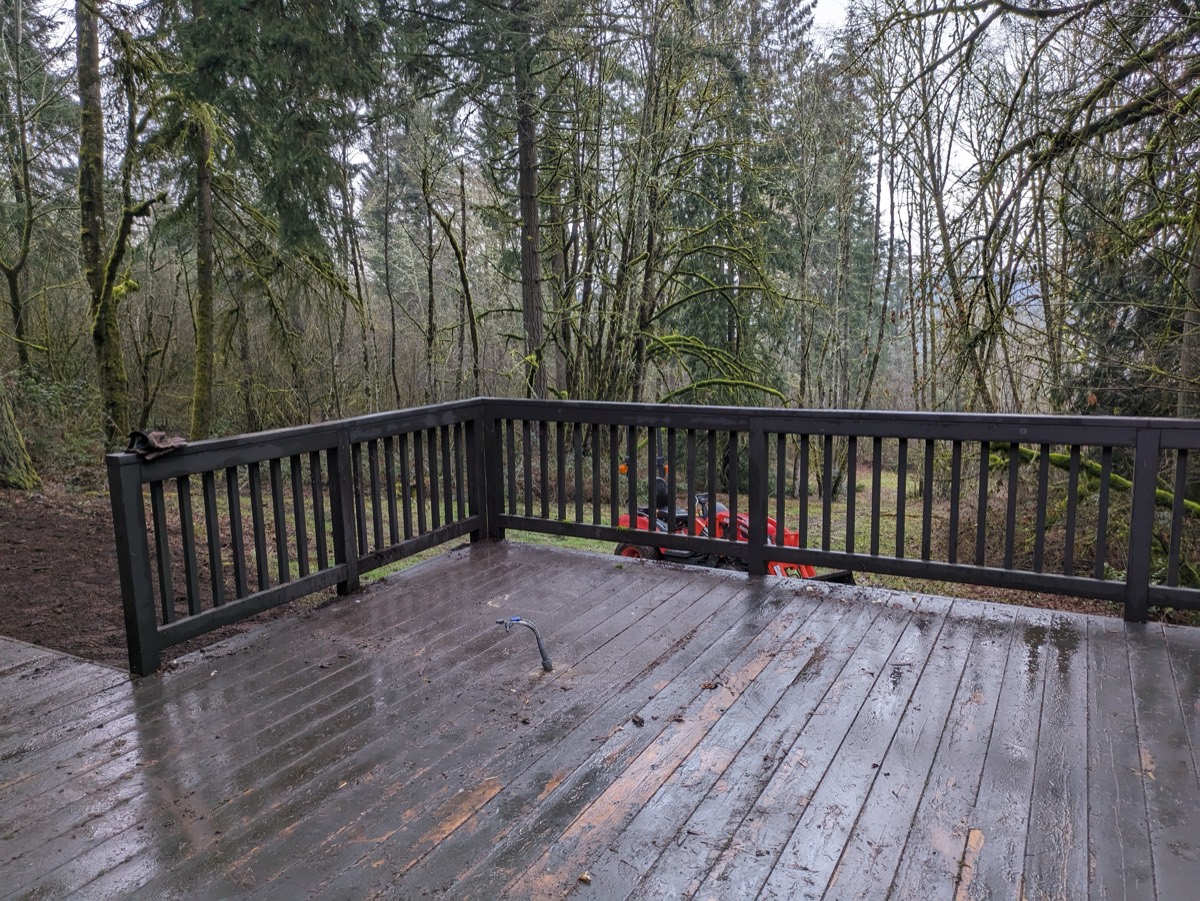
Rather not deal with it? We remove hot tubs from $349 — cut-down, haul-away and disposal included.
Get a hot tub removal quote ↗Sunken hot tub removal: when the deck was built around it
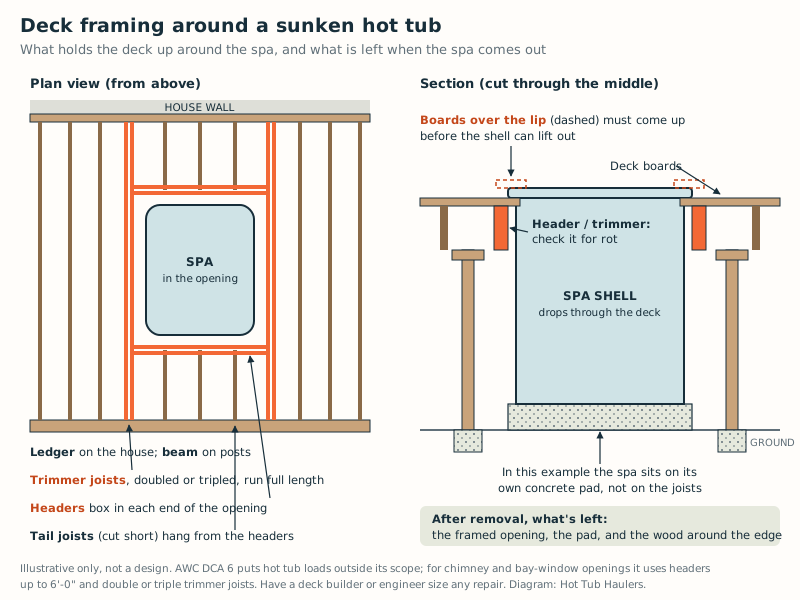
A deck-sunk spa drops through an opening in the deck, with its lip at or near board height. The deck framing is boxed in around it, and the spa sits on whatever base was built for it below, such as a concrete pad. How much of the deck has to come apart depends on one detail: whether the boards run over the spa's lip or stop against it.
- Boards stop at the lip. The shell can often be cut and lifted out in pieces with the deck intact.
- Boards run over the lip. Those boards have to come up first. Unscrew them rather than cutting them, and stack them if you plan to reuse them.
- Pieces come up, not across. You're lifting sections up out of a hole, so cut them smaller than you would on a patio.
- Mind the edge. Once the tub is out you have an open hole in the deck. Cover it or rope it off until it's framed over or filled.
A photo of the edge where the deck meets the spa usually tells a removal company what's involved.
In-ground hot tub removal and demolition permits
Carrying a freestanding tub off a deck is hauling. Cutting out part of a deck, or breaking a spa out of the ground, is closer to demolition, and many cities treat it that way. Few city pages name hot tubs. Most write their rules for in-ground pools, decks or "structures." From the permit rules on our city guides:
| City | What the city says |
|---|---|
| Apple Valley, MN | In-ground pool removal takes a demolition permit with a marked-up lot survey, plus electrical and, for gas, mechanical permits. All concrete must leave the site. Attached decks need a building permit. No page covers spas. |
| Burnsville, MN | A permit before every residential project, decks included. Removing an in-ground pool takes a $25.50 City demolition permit, with gas, electrical and plumbing terminated first. No page covers an in-ground spa or its deck. |
| Maricopa, AZ | A $167 residential demolition permit, applied for through the city's online portal. No city page says which spa or deck removals need one, so ask Development Services before breaking up a slab, deck or in-ground spa. |
| Scottsdale, AZ | Demolishing or removing an in-ground pool or spa needs a Demo Permit, applied for as a Minimum Permit without plan review. |
| Glendale, AZ | A building permit to demolish and fill an in-ground pool or spa: a 24-by-24-inch hole in the bottom, inspection before backfill, and above-ground plumbing, pumps and heaters removed. |
| Peoria, AZ | Filling in an in-ground spa always needs a permit. Remove the shell and compact certified fill, or leave the shell with 24-inch drainage holes and a recorded note that the site may not be suitable for building. |
| St. Paul, MN | A general building permit to demolish decks and similar structures. Low decks under 30 inches that aren't attached with frost footings and aren't a door landing are exempt. Filling an in-ground pool needs a grading permit. |
The pattern: in-ground work almost always needs a permit, and deck work often does. Spa-specific rules are rare, so call before you cut. Utilities matter too. Burnsville and Apple Valley want gas, electrical and plumbing terminated or permitted, and our Maricopa guide says to call 811 at least two working days before any digging. For a freestanding tub the electrical rules are covered in do you need a permit to disconnect a hot tub. Find your city's rule on our service areas page. This is a summary, not legal advice.
Filling the hole is usually a separate trade and a separate price from removing the tub, so don't assume a removal quote covers the ground.
What's left after the hot tub is gone
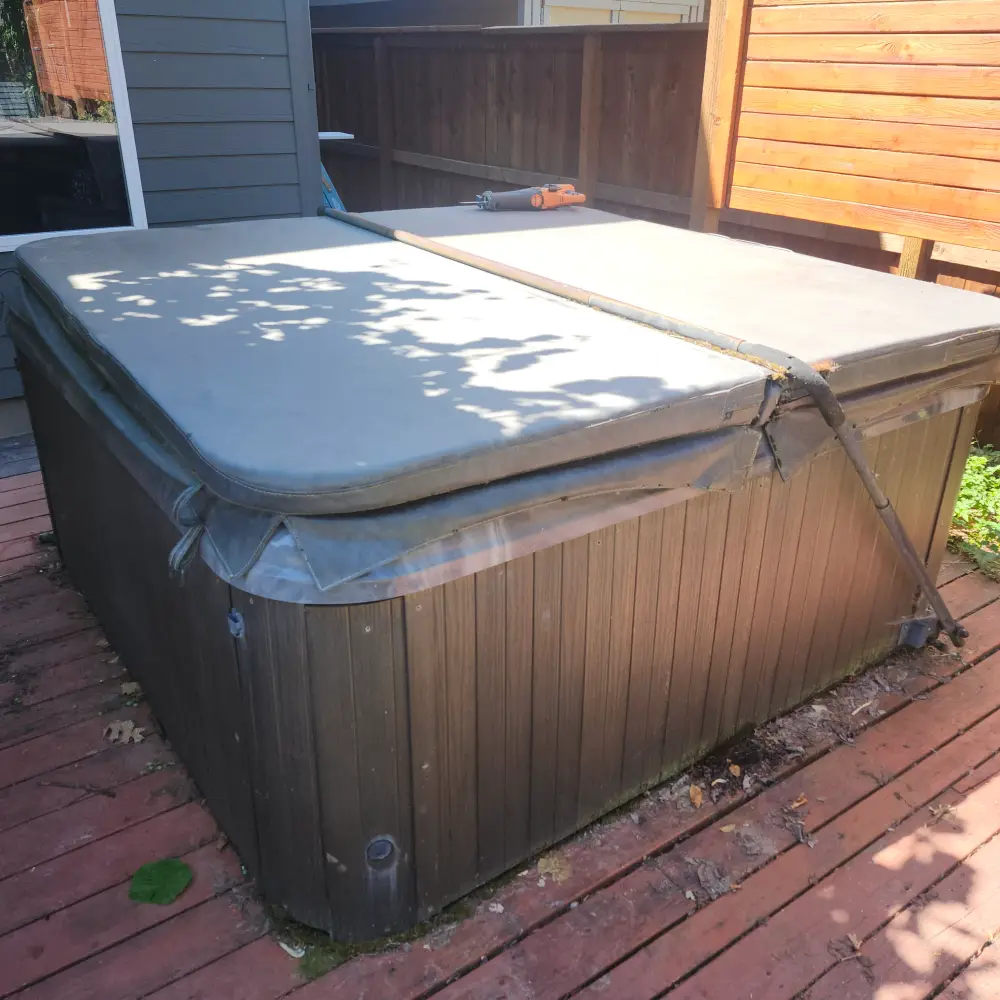
Removal exposes the part of the deck that has been shaded and damp for years.
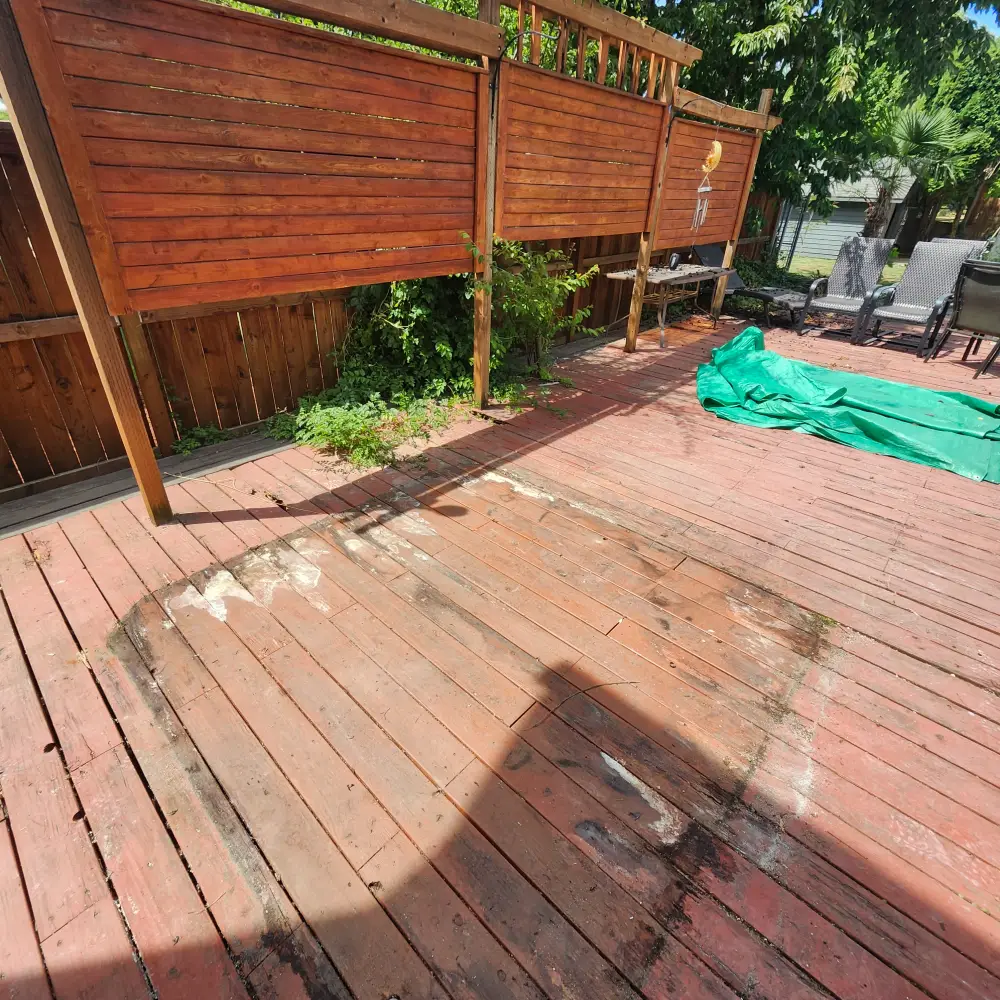
Rot and water damage: how to check
NADRA's consumer checklist is a good homeowner's test. It says to check the ledger board, the support posts and joists under the deck where you can reach them, deck boards, railings and stairs, and to "Pay special attention to any areas that tend to remain damp, are regularly exposed to water, or are in contact with fasteners." Under a hot tub, that's everything.
- The probe test. Push an ice pick or screwdriver into the wood. NADRA says that if you can easily penetrate ¼ to ½ inch, can break off a sliver without splinters, or the wood is soft and spongy, decay may be present.
- Fasteners. Look for loose, popped or corroded nails and screws. NADRA notes a corroded fastener can cause deterioration in the surrounding wood.
- Sag and sway. NADRA says the deck and stairs should look even, without sagging, and should not sway or move when tested. A dip where the tub sat is a warning sign.
- From below. If you can get under the deck, look at the joists, beam and posts directly under the footprint, and at the ledger where the deck meets the house.
NADRA's checklist ends with a caveat worth repeating: checking a deck this way doesn't make it code compliant. For a real evaluation it says to seek a professional such as a deck builder or home inspector.
The opening and the framing
A deck-sunk spa leaves a framed hole. That framing was boxed in to carry the cut joists around the tub. DCA 6 doesn't cover hot tubs, but its detail for framing around a chimney or bay window shows the same idea:
- Headers may span a maximum of 6'-0". Wider openings need one or more 6x6 posts to shorten the span.
- Triple trimmer joists are required on each side of the header if joists are spaced 12 or 16 inches on center, or if the trimmer span exceeds 8'-6"; otherwise double trimmers are permitted.
- Joist hangers need minimum capacities, for example 870 lb for a 2x6 trimmer and 1,155 lb for a 2x8.
When the tub is gone you can either keep the opening, for a new drop-in spa, or close it in. Closing it means running new joists across the gap, tied into the framing at each end. Have a deck builder size and connect them, and check the headers and trimmers for rot first, since they sat right beside the wet edge of the spa.
Re-decking the footprint
Stained or soft boards under a tub are usually easier to replace than to save. DCA 6's decking requirements are a good minimum standard for the patch:
- Decking is 2-inch nominal dimension lumber or span-rated decking.
- Attach decking to each joist with two 8d threaded nails or two #8 screws, and space boards about ⅛ inch apart.
- Each segment of decking must bear on a minimum of 3 joists, so short patch pieces that span only two joists don't meet it.
- Cut ends of treated lumber get a field-applied preservative, such as copper naphthenate.
- Fasteners for treated wood are hot-dipped galvanized, stainless steel, silicon bronze or copper.
Re-decking can be permitted work. Lakeville, MN, for example, applies a re-deck permit when the entire decking or railing is removed and replaced. Ask your city before a large patch.
Filling the hole from an in-ground spa
For a spa set in the ground, follow the city rules above. In Peoria and Glendale, filling is a permitted, inspected job, and proper fill and compaction are what make the ground usable again.
The concrete pad
A ground-level tub, or a sunken one, often leaves a slab. Hot Spring requires a reinforced pad at least 4 inches thick for its Grandee and Envoy models, so a sound spa pad can be a good base for a new tub, a shed or seating. If you'd rather lose it, breaking up a slab is demolition work: Maricopa's guide says to ask Development Services before breaking up a slab, and Apple Valley requires all concrete to leave the site on pool demolitions. Call 811 before you dig.
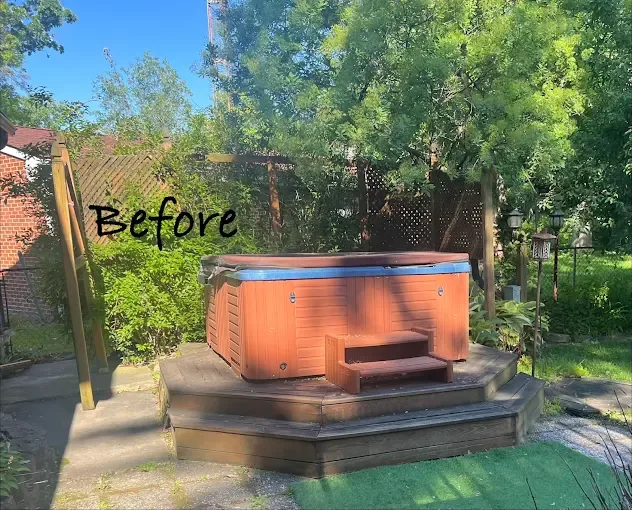
Repurposing the space
- A new hot tub. Don't assume the old spot is good enough. Hot Spring says the spa's weight per square foot "must not exceed the structure's rated capacity," and to consult a qualified building contractor or structural engineer before placing a spa on an elevated deck.
- Big planters. DCA 6 lists planters with hot tubs as concentrated loads outside its scope. A row of wet soil in big pots is heavier than it looks.
- Fire pits and heaters. NADRA says to keep any fire or heat source away from flammable surfaces, or protect the deck with a non-flammable pad.
- Seating or open deck, once the boards and framing are sound.
When to call a deck builder, engineer or inspector
Call before you use the space again if any of these apply:
- Any board, joist, beam or post fails the probe test, or the deck sags or moves.
- The tub was sunk into the deck and the opening needs closing or re-framing.
- Framing was cut or notched to fit the tub or its plumbing.
- The ledger or its flashing looks wet, rusty or loose. NADRA calls the ledger a common source of deck failure.
- You're putting a new spa, a big planter or a heavy outdoor kitchen on the deck. All are concentrated loads.
- The work needs a permit. DCA 6 says decks shall not be used or occupied until final inspection and approval is obtained.
An inspector finds problems, a deck builder fixes them, and a structural engineer sizes framing for a new spa. This isn't engineering advice; codes vary by jurisdiction.
Mistakes to avoid
- Working around a full tub on an elevated deck. Drain it first.
- Cutting before a licensed electrician has disconnected the circuit.
- Carrying pieces too big for the stairs, or with too few people.
- Leaving the opening from a sunken spa uncovered.
- Re-decking over soft framing because the new boards look fine.
- Assuming a removal price covers re-decking, filling or pad removal. Those are separate jobs.
We remove deck-mounted and deck-sunk hot tubs
Hot tub removal is all we do, and decks are part of it. Send us photos of the tub, the edge where it meets the deck, the stairs or route out, and your ZIP. We'll quote from the photos. Our price starts at $349 and includes cutting the tub down, carrying it out, hauling it away and disposal. We're insured. Have the tub disconnected by a licensed electrician before removal day; if it's still hard-wired, tell us and we'll talk it through. Drain it if you can; tell us if you can't. See pricing.
Rather not deal with it? We remove hot tubs from $349 — cut-down, haul-away and disposal included.
Get a hot tub removal quote ↗Frequently asked questions
Can a deck hold a hot tub?
Only if it was built for one. The IRC's minimum deck live load is 40 lb per square foot, while Hot Spring asks for a deck that can withstand more than 115 to 130 lb per square foot for its Highlife models. Have a deck builder or structural engineer confirm before a spa goes on an elevated deck.
How do you get a hot tub off a raised deck?
Drain it, have a licensed electrician disconnect it, then cut the empty shell into sections on the deck and carry them down the stairs or off the side. Whole-tub lifts on a dolly or by crane are for tubs being kept, or where nothing can be carried.
Do I need a permit to remove a hot tub from a deck?
Hauling away a freestanding tub usually isn't permitted work, but cutting a deck or removing a sunken or in-ground spa can be. Scottsdale needs a demo permit for an in-ground spa, Glendale a building permit to demolish and fill one, and Apple Valley and Burnsville require demolition permits for in-ground pools. Ask your building department first.
What do you do with a deck after removing a hot tub?
Clean the footprint, then check the boards and the framing under it for soft or decayed wood and loose or corroded fasteners. Then re-deck the area, frame and deck over an opening, or reuse the space. Have a deck builder look at anything soft, sagging or cut.
Can you leave the concrete pad after hot tub removal?
Usually, yes. A sound pad can stay as the base for a new spa, a shed or seating; Hot Spring's minimum for its largest models is 4 inches of reinforced concrete. If you break it up, ask whether your city needs a permit, and call 811 before digging.
Sources
- American Wood Council: DCA 6, Prescriptive Residential Wood Deck Construction Guide (2015 IRC), with commentary (PDF)
- NADRA: Check Your Deck consumer checklist (PDF)
- Hot Spring Highlife Collection pre-delivery instructions 2026 (PDF)
- City of Apple Valley, MN: Demolition of Buildings & Pools
- City of Apple Valley, MN: Deck
- City of Burnsville, MN: Residential Building Permit
- City of Burnsville, MN: Swimming Pool Demolition Requirements (PDF)
- City of Maricopa, AZ: Development Fee Schedule (PDF)
- City of Maricopa, AZ: Development Services FAQs
- City of Scottsdale, AZ: Home improvement permits
- City of Glendale, AZ: Swimming pool demolition (PDF)
- City of Peoria, AZ: Handout 511, pool and spa removal (PDF)
- City of St. Paul, MN: When is a building permit required? (PDF)
- City of Lakeville, MN: Re-deck permit (PDF)
- Hot Tub Haulers city guides: permit rules, reviewed September–October 2026