The disconnect is the most-asked electrical question about hot tubs. It decides where the box goes when a spa is installed. It also decides what has to happen when a spa comes out. This guide covers both: what the code says, what the manufacturers say, and what "disconnected" means on removal day.
Key takeaways
- 5 ft minimum. The maintenance disconnect must be at least 5 ft horizontally from the inside wall of the spa, unless a permanent barrier makes the reach path 5 ft or more (NEC 680.13).
- Within sight. It must be readily accessible and within sight of the spa equipment: visible and not more than 50 ft away.
- GFCI. The outlet supplying the spa must be GFCI protected (NEC 680.44).
- Local adoption varies. Cities adopt different NEC editions, with amendments. Your inspector has the final say.
- For removal: power off at the breaker, then a licensed electrician disconnects the spa and deals with the circuit. Plug-in 120V spas just unplug.
What a hot tub disconnect is
A spa disconnect is a switch that cuts power to every ungrounded ("hot") conductor feeding the spa at once. On most 240V hot tubs it is a weatherproof box mounted on an exterior wall or a post near the tub. Inside is usually a GFCI breaker, so the same box gives both the shutoff and the ground-fault protection. Hot Spring describes exactly that setup: a GFCI breaker in a weatherproof box, no less than five feet from the hot tub and clearly visible from it.
It exists so that someone servicing the spa can kill the power right where they are working, and see that it stays off. That is why the NEC calls it the maintenance disconnecting means.
Hot tub disconnect requirements under NEC Article 680
Article 680 of the National Electrical Code (NFPA 70) covers pools, spas and hot tubs. Three rules matter most for an outdoor residential spa.
1. The disconnect: NEC 680.13
In the 2017 NEC, section 680.13 requires one or more means to disconnect all ungrounded conductors simultaneously for all the utilization equipment other than lighting. Each means must be:
- readily accessible;
- within sight from its equipment; and
- at least 1.5 m (5 ft) horizontally from the inside walls of the spa or hot tub, unless it is separated from the open water by a permanently installed barrier that provides a 5 ft reach path or greater.
The distance is measured horizontally from the water's edge along the shortest path someone would take to reach the switch. Older editions carried the same rule under 680.12, which is how Mike Holt's 2009 EC&M commentary numbers it. Section numbers can move between editions, so check the number in the edition your jurisdiction has adopted.
2. "Within sight": visible and no more than 50 ft
The 2023 NEC added section 110.29 to pin the phrase down: equipment that must be "within sight of" other equipment has to be visible from it and not more than 15 m (50 ft) away. Article 100 still carries the same definition. In practice, both tests apply. A breaker 30 ft away but around the corner of the house fails. So does one in plain view 60 ft down the yard.
3. GFCI protection: NEC 680.44
The outlet that supplies a self-contained spa or hot tub, a packaged spa equipment assembly, or a field-assembled spa must be GFCI protected. In the 2023 edition, 680.44(A) allows GFCI protection under 680.5(B) or SPGFCI (special-purpose GFCI) protection under 680.5(C), as applicable. A listed unit or packaged assembly with integral GFCI protection for all its electrical parts can be exempt from additional protection if it is marked for that (680.44(B)). The 2023 edition also added 680.44(C) for gas-fired spa heaters on their own circuits.
A note on emergency shutoffs
You may also see 680.41, the emergency shutoff. Mike Holt's 2017 summary describes it as readily accessible to users, at least 5 ft away, adjacent to and within sight of the spa. It is generally aimed at public and commercial spas rather than backyard tubs; ask your inspector whether it applies to yours. For a typical home spa, the 680.13 maintenance disconnect is the one that matters.
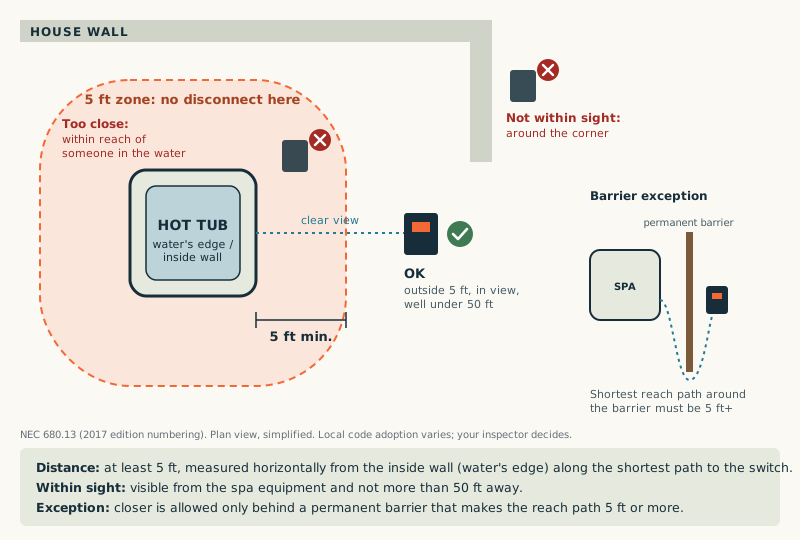
Hot tub disconnect distance: common situations
| Where the disconnect is | Usually meets 680.13? | Why |
|---|---|---|
| On the house wall 8 ft from the tub, in plain view | Yes | Outside 5 ft, visible, well under 50 ft. |
| On a post 3 ft from the tub | No | Within reach of someone in the water. |
| 3 ft away, behind a permanent fence; the walk around the fence is 6 ft | Possibly | The barrier exception: the shortest reach path is what counts. Ask your inspector. |
| Only at the main panel in the garage | Usually no | Not within sight of the spa, unless it is visible and within 50 ft. |
| Beside the tub on a 120V cord-and-plug spa | Different case | Plug-in spas use a GFCI on the cord or receptacle. Follow the manual. |
What the manufacturers ask for
Manufacturers write the code rules into their installation instructions and add their own circuit sizes. Two examples:
- Jacuzzi says most full-size models in North America run on 240V and typically need a 50-amp GFCI breaker, with some models calling for 40 or 60 amps. It places the disconnect at least 5 ft from the inside wall of the tub, within line of sight, and strongly recommends a licensed electrician for all hot tub electrical work. It also notes that most jurisdictions require permits and inspections.
- Hot Spring calls for a GFCI breaker in a weatherproof box no less than 5 ft from the tub and clearly visible from it, mounted on an exterior wall, deck post or ground-anchored post. All connections to the control box must be made by a qualified electrician under the NEC and local codes.
Your spa's own manual is the document to follow. Amperage, wire size and GFCI type depend on the model, its heater and its pumps.
Plug-and-play 120V spas
Smaller spas often run on 120V. Jacuzzi says many compact models draw 15–20 amps on a dedicated circuit and plug into a standard NEMA 5-15 or 5-20 outdoor receptacle, with GFCI protection built into the cord. Hot Spring points out the main convenience: a plug-and-play spa can simply be unplugged when it is moved. Some 120V spas can be converted to 240V, so check how yours is actually wired before assuming it is plug-in.
Safety first. Hot tub circuits are high-current, outdoors and next to water. Don't open the disconnect box, remove the pack cover or touch the supply wiring. Electrical work on a spa is a job for a licensed electrician, with the power off at the breaker.
How to disconnect a hot tub for removal
This is the part that matters if the spa is going away. There are two jobs here, and only the first is yours.
What you can do: turn it off
- Switch the spa off at its breaker. Turn off the GFCI breaker in the spa disconnect box and the spa breaker at the main panel if there is one.
- Unplug a 120V spa. If the spa is cord-and-plug, unplug it from the receptacle.
- Check the panel goes dark. The topside control panel should not light up. This is a check that it is off, not proof the wiring is dead.
- Leave the box closed. Don't take anything apart.
What a licensed electrician does
A hard-wired spa has supply conductors running from the disconnect box to the spa's equipment pack. Before a removal crew can move or cut the tub, those conductors must be disconnected at the spa by an electrician who has locked off and tested the circuit. We don't publish wiring steps, because this is not DIY work.
The electrician will also ask what you want to happen to the circuit afterwards. That is a separate decision, covered below.
What "disconnected" means for a removal crew
When a removal company says the tub "must be disconnected," it means the spa is no longer attached to the house's electrical system in any way. In plain terms:
- the breaker is off;
- no supply wiring runs from the disconnect box or the house into the spa cabinet;
- a plug-in spa is unplugged and the cord is free;
- nothing else on the property, such as lights or a gas heater, still feeds into the tub.
This matters because removal crews cut through cabinets and shells, and lift or slide tubs across decks. A spa can be cut into sections before it is carried out (how a hot tub is cut down). Any live or attached conductor in that path is a hazard.
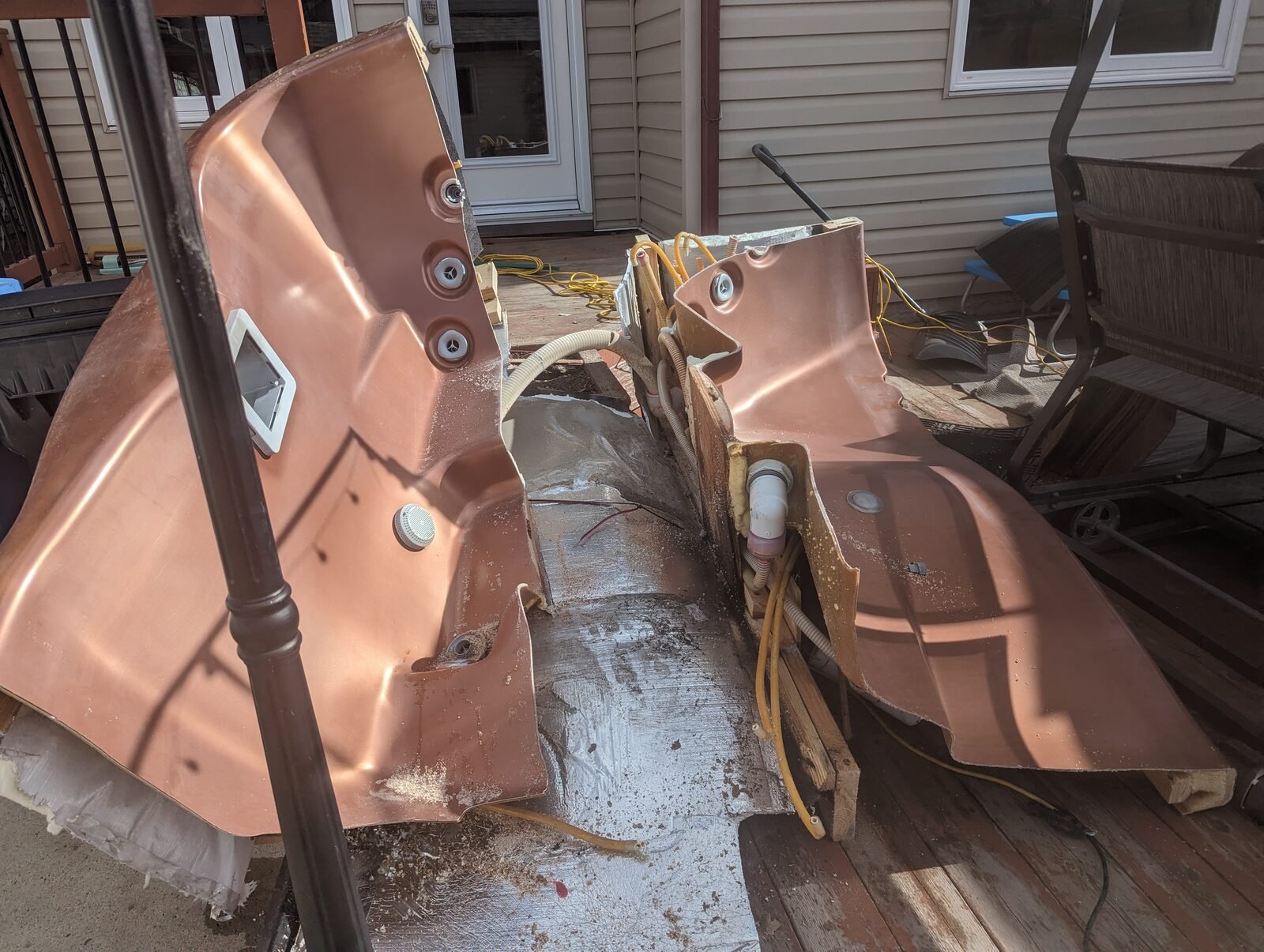
How we handle it
Before we remove a tub, it must be disconnected by a licensed electrician. If yours is still hard-wired, tell us in your request and we'll talk it through. If you can drain it, do; tell us if you can't. A photo of the disconnect box and the side of the tub where the wiring enters helps us quote accurately.
Rather not deal with it? We remove hot tubs from $349 — cut-down, haul-away and disposal included.
Get a hot tub removal quote ↗What happens to the circuit after the hot tub is gone
Turning off the breaker makes a removal safe. It doesn't settle the wiring. Once the tub is out you still have a breaker, a run of wire and usually a disconnect box on the wall. An electrician generally takes one of two routes:
| Cap and terminate | Remove back to the panel | |
|---|---|---|
| What it is | Conductors are terminated safely and the circuit left de-energized, ready for a future spa | Wiring, disconnect box and breaker are taken out |
| Good for | You plan to put another spa in the same spot | The spa area is becoming a patio, lawn or garden; selling the home |
| Permit | Often required either way. It depends on your jurisdiction. | |
Some local rules are specific. Scottsdale's hot tub and spa rules say a demolition permit is required to inspect electrical and plumbing removal. Apple Valley, MN requires an electrical permit to terminate the power supply when a pool is removed. Maricopa County's in-ground pool and spa demolition rule, quoted on our Sun City page, requires equipment and electrical to be removed back to the panel. For the full picture, and how to check your address in one call, see do you need a permit to disconnect a hot tub? and what happens to the spa circuit.
Local rules we have checked
Each of our city pages quotes the published electrical rule where we could find one. A few examples:
- Scottsdale, AZ: a demolition permit covers inspection of electrical and plumbing removal; altering an existing circuit needs a minimum permit.
- Apple Valley, MN: an electrical permit is required to terminate power when a pool is removed. No page names hot tubs, so ask.
- Bloomington, MN: a permit is required whenever wiring is changed, altered or removed. The fee list has a $65 line for hot tub, pool or spa wiring.
- Goodyear, AZ and Avondale, AZ: unplugging portable equipment is exempt, so a plug-in spa can simply be unplugged. Taking out a hard-wired spa circuit is not on the exempt list.
- Surprise, AZ and Highlands Ranch (Douglas County), CO: both enforce the 2023 NEC, a reminder that the edition in force is set locally.
Plug-in 120V spas: the simple case
If your spa plugs into a receptacle, disconnecting it for removal usually means unplugging it. Some cities say so directly: Goodyear and Avondale exempt plugging portable equipment into an existing receptacle from permits. The receptacle stays. If it is a dedicated outdoor GFCI receptacle, you can keep it for other uses or have an electrician change it later.
Two checks first. Make sure the spa really is plug-in, since some are converted to 240V and hard-wired. And look for anything else wired to the tub, such as add-on lighting.
Mistakes to avoid
- Treating "breaker off" as "disconnected." The supply wiring is still attached to the spa.
- Cutting wires to "make it safe." Never cut, pull or disconnect spa wiring yourself. A mislabeled breaker can leave a conductor live.
- Leaving a live circuit to an empty box. It is a common home-inspection write-up, and harder to fix under a closing deadline.
- Skipping the permit question. Ask your building department before the work, not after.
- Booking removal before the electrician. Get the disconnection on the calendar first.
Checklist before removal day
- Find the spa breaker and the disconnect box. Take photos of both.
- Decide whether you want the circuit capped for a future spa or removed.
- Call your building department and ask whether that work needs a permit.
- Book a licensed electrician to disconnect the spa and do the circuit work.
- Drain the tub if you can, following local discharge rules (how to drain a hot tub). Tell us if you can't.
- Send us photos of the tub, the access route and your ZIP for a quote.
Thinking of selling instead of removing it? A working spa sometimes finds a buyer. See selling a used hot tub. The buyer's electrician will need the same disconnection before it moves.
What this page is not
This guide summarizes published code commentary and manufacturer instructions. It is not electrical advice, and it is not a substitute for the code edition your jurisdiction has adopted, its local amendments, or your spa's installation manual. NFPA publishes the NEC, and the authority having jurisdiction, usually your city or county building department, decides how it applies to your property.
Rather not deal with it? We remove hot tubs from $349 — cut-down, haul-away and disposal included.
Get a hot tub removal quote ↗See what hot tub removal costs, our pricing or check the areas we serve.
Frequently asked questions
How far does a hot tub disconnect have to be from the tub?
At least 5 ft, measured horizontally from the inside wall of the spa along the shortest path to the switch. It can be closer only if a permanently installed barrier makes that reach path 5 ft or more. This is NEC 680.13; confirm the edition your jurisdiction has adopted.
Is there a maximum distance for a spa disconnect?
Yes, indirectly. The disconnect must be within sight of the spa equipment, and the NEC defines within sight as visible and not more than 50 ft away. A breaker in a garage panel around the corner does not meet that on its own.
Does a hot tub need a GFCI?
Yes. NEC 680.44 requires GFCI protection for the outlet that supplies a self-contained spa, a packaged spa equipment assembly or a field-assembled spa. A listed unit with integral GFCI protection marked for it is the exception, and the 2023 edition also allows SPGFCI where applicable.
Can I disconnect my own hot tub for removal?
You can switch it off at the breaker and, on a 120V plug-in spa, unplug it. Anything beyond that, such as removing wires from the disconnect box or capping the circuit, is electrical work for a licensed electrician and often needs a permit.
Does a hot tub removal company disconnect the electrical?
Don't assume it. We ask for the tub to be disconnected by a licensed electrician before removal day. If yours is still hard-wired, tell us in your request and we'll talk it through.
What happens to the hot tub wiring after the tub is gone?
A licensed electrician either caps and terminates the circuit or removes it back to the panel, depending on local rules and your plans for the space. Many jurisdictions treat this as permitted work.
Sources
- EC&M (Mike Holt): Spas, Hot Tubs, and Hydromassage Tubs, 2017 NEC
- EC&M (Mike Holt): Pools and Spas, Part 1 of 3 (earlier 680.12 numbering)
- ExpertCE: 2023 NEC 680.44 GFCI and SPGFCI protection for spas and hot tubs
- ExpertCE: 2023 NEC 110.29, "in sight from" (visible, not more than 50 ft)
- Jacuzzi: Hot tub wiring and electrical requirements
- Hot Spring: Preparing for the wiring of a 240V hot tub
- City of Scottsdale: Swimming pools, hot tubs and spas
- City of Apple Valley: Demolition of buildings and pools
- City of Bloomington, MN: Permit information and fees
- Goodyear City Code 9-1-1 (building code amendments)
- Avondale amendments to the 2024 International Codes
- Surprise: currently adopted building codes
- Maricopa County: Pool and spa demolition
- Douglas County, CO: Electrical permit