Key takeaways
- Hot tubs are only partly recyclable. The metal has a real recycling stream. The shell usually doesn't.
- The recyclable parts are the pumps, motors, heater and a steel frame. Motors have copper windings inside a steel housing.
- The shell goes to landfill because of how it's built. Acrylic, fiberglass resin and sprayed polyurethane foam are bonded together and can't be separated economically.
- Scrap yards want metal only. Take the equipment out, strip off the plastic, and call before you go.
- Your county's disposal guide is the best "near me" search. Several name a hot tub entry and say exactly where each part can go.
"Can I recycle my hot tub?" has an honest answer: some of it. A spa is a handful of materials. Two or three of them recycle well. The biggest part, the shell, almost never does. Here's which is which, why, and how to find a recycler for the parts that can go.
What a hot tub is made of
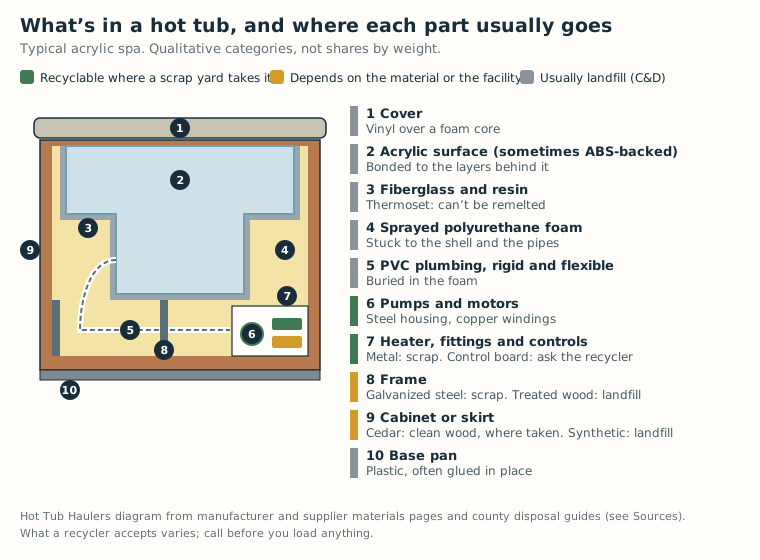
We cover the layers briefly in what a hot tub is made of. Here's the same spa part by part, with what manufacturers and their suppliers say about each material.
| Part | Material | What the sources say |
|---|---|---|
| Shell surface | Acrylic, sometimes ABS-backed | Hot Spring says an acrylic shell starts as a single sheet, heated and placed over a mold, and that some shells add a layer of ABS before molding. Arctic Spas heats its sheet to 365 degrees in a vacuum former. |
| Shell reinforcement | Fiberglass and resin | Hot Spring: the shell is "reinforced with a combination of resin and fiberglass." Arctic Spas sprays fiberglass onto the underside. |
| Insulation | Sprayed polyurethane foam | A Graco case study describes Dimension One Spas spraying urethane foam to fill spa cavities. Carpenter sells open-cell, closed-cell and high-density polyurethane systems for hot tubs. |
| Plumbing | Rigid and flexible PVC | Kuriyama's PVC "spa hose" is sold for "spa, pool and hot tub plumbing." In a full-foam spa, these lines are buried in the foam. |
| Pumps and blower | Steel, copper windings | Hot Spring's 2021 Grandee spec sheet lists two 2.5 HP jet pumps and a separate circulation pump. |
| Heater and controls | Metal element, fittings, circuit board | The same spec sheet lists a titanium 4,000 W heater and a control system with a GFCI-protected sub-panel. |
| Frame and base | Steel or wood frame; plastic base | Piedmont Plastics says HMWPE (high molecular weight polyethylene) is used as a liner for the bottom of the spa frame. |
| Cabinet | Synthetic wood, cedar or composite plastic | Sundance: cabinets are "typically constructed from weather-resistant materials such as synthetic wood, cedar, or composite plastics." |
| Cover | Vinyl over a foam core | The Grandee sheet lists a vinyl cover with a tapered foam core of 2 lb density. |
Which parts can realistically be recycled
Pump motors and the blower
These are the best bet. A motor is a steel housing around copper windings, and scrap yards buy motors as a grade of their own. Sahd Metal Recycling, a Pennsylvania scrap yard, lists small motors, large motors and pumps in that category, and says AC motors average 7 to 9 percent copper by weight. It also warns that motors with aluminum windings are very low grade and often go in with lower-grade steel. A file or a dent shows which you have: orange is copper.
The heater and fittings
The heater element and its metal fittings can go with other scrap metal once the plastic housing and PVC are off. The control board is mixed electronics, not metal scrap. Ask the yard, or your county's electronics program, whether it takes one.
A steel frame
Some spas sit on a galvanized steel frame; others use wood. Steel has a well-established recycling stream. The EPA estimated that 27.8 percent of the ferrous metals in durable goods such as appliances and furniture were recycled in 2018, and 59.8 percent of all materials in appliances. A frame has to come out clean, though. Hennepin County's scrap metal rules are typical: pieces 4 feet or less, all non-metal parts removed.
Some wood
A cedar skirt or untreated wood frame may be accepted as clean wood where a facility takes it. Treated wood usually isn't. Olmsted County's Kalmar Landfill, for example, accepts untreated wood in its construction and demolition cell but rejects treated plywood, particle board and green lumber. Synthetic skirt panels go with the shell.
Rather not deal with it? We remove hot tubs from $349 — cut-down, haul-away and disposal included.
Get a hot tub removal quote ↗What usually goes to landfill, and why
The shell, the foam, the buried plumbing, the base pan and the cover: everything bonded together, plus the cover.
The materials are bonded, not assembled
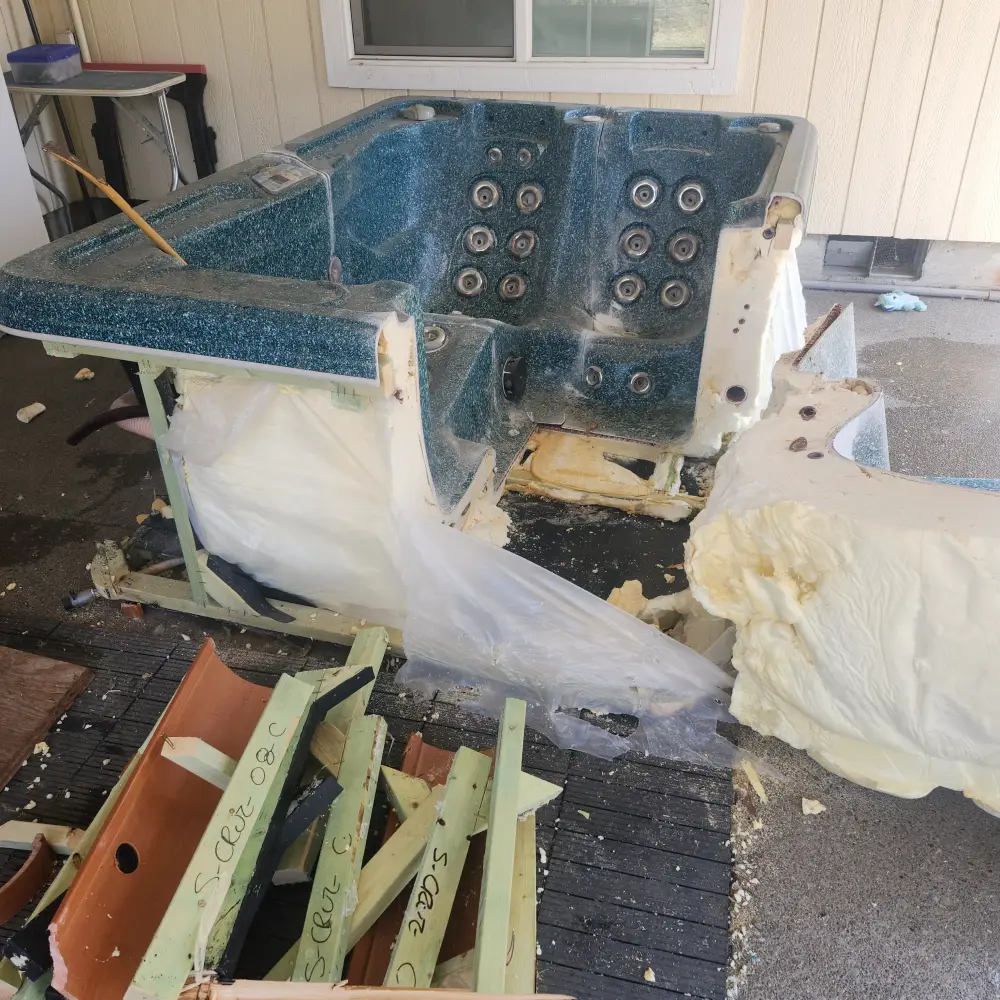
A refrigerator comes apart with tools. A spa shell doesn't. The acrylic is backed with fiberglass and resin, and the foam is sprayed onto that. There's no clean layer to peel away. To recycle any one material, you'd first have to strip it from the other two.
Fiberglass resin can't be remelted
The resin in fiberglass is a thermoset. Once it cures, it can't be melted down the way many plastics can. In a 2021 review of composite reuse, Albert ten Busschen writes that the cross-linked resin "must be decomposed because it cannot be melted," and that no industrial method for recovering the original materials is yet financially viable.
There is one industrial route. In cement-kiln co-processing, ground-up fiberglass replaces some of the raw minerals and fuel in cement making. The American Composites Manufacturers Association described it in 2016, with the operations it named in Germany and the Netherlands. That isn't a drop-off option for a homeowner, and none of the county disposal guides we checked offer one for spa shells.
What county guides actually say
- Hennepin County, MN: its drop-off facilities "do not accept plastic bathtubs, porcelain bathtubs or fiberglass bathtubs," and says they may go in the garbage.
- Olmsted County, MN: Kalmar Landfill's construction and demolition cell lists molded fiberglass as acceptable.
- Alameda County, CA: StopWaste's RE:Source entry for hot tubs puts reuse and repair first, lists transfer stations for disposal, and names a recycler for "metal only."
The cover goes the same way. It's vinyl around foam, and the City of Coon Rapids, Minnesota, Recycling Center lists hot tub covers among the items it doesn't accept. Material by material, where a removed tub ends up.
Be wary of recycling percentages
If someone says a hot tub is "90% recycled," ask how they measured it. The metal in a spa is real, but it's only a few of the parts, and the shell isn't one of them. We don't publish a percentage because we haven't weighed one.
Hot tub recycling near me: how to find a scrap yard
- Start with your county's disposal guide. Search your county or city name plus "disposal guide," "waste wizard" or "recyclopedia," and look up "hot tub." Madison, Wisconsin's Recyclopedia has a hot tub entry, and Olmsted County's Waste Wizard has one for a hot tub and cover.
- Then search for scrap metal recyclers. The EPA's advice for metal is simply that programs vary by locality, so check what's available in your area. Search "scrap metal recycling" with your city.
- Call before you load. Ask whether they take electric motors and pumps whole, whether they pay for them, and how clean steel has to be.
- Prepare the metal. Take the pumps, heater and frame out. Strip off plastic, PVC and foam. Drain any water. Hennepin County, for example, asks for fluids to be removed 24 hours before drop-off.
- Keep your expectations modest. Scrap value from one spa is small. It won't pay for the removal. What's actually worth recovering.
Never take apart a tub that's still connected. The power must be off at the breaker and the tub disconnected by a licensed electrician first. Cutting fiberglass and foam needs a respirator and eye protection.
What removal companies do with the parts
A typical removal follows the same order as a DIY one. The equipment comes out before the shell is cut, so the metal can be kept apart from the rest. The metal goes to scrap where a recycler takes it. The shell, foam and plumbing go to construction and demolition disposal. How a hot tub is cut down.
That's how we work too. We separate the metal for scrap where a recycler near the job takes it, and the rest goes to disposal, which is included in our price from $349. If you're comparing companies, ask each one whether disposal is in the price and what happens to the metal.
If your tub still works, the best outcome isn't recycling at all. It's reuse. Run the reuse test first, and see all the ways to get rid of a hot tub.
Rather not deal with it? We remove hot tubs from $349 — cut-down, haul-away and disposal included.
Get a hot tub removal quote ↗Frequently asked questions
Can hot tubs be recycled?
Partly. The metal parts, such as pump motors, the heater and a steel frame, can go to a scrap metal recycler. The shell, acrylic bonded to fiberglass and sprayed foam, usually can't be recycled and goes to a construction and demolition landfill.
What parts of a hot tub are recyclable?
Mainly the metal: pump and blower motors with copper windings, the heater and its fittings, a galvanized steel frame, and a metal cover lifter. Untreated wood such as a cedar skirt may be accepted for clean-wood recycling where a facility takes it.
Is a fiberglass hot tub shell recyclable?
Not in practice for a homeowner. Cured fiberglass resin is a thermoset that can't be remelted, and in a spa it's also bonded to foam. Hennepin County, Minnesota, for example, sends fiberglass bathtubs to the garbage rather than recycling.
Will a scrap yard take a whole hot tub?
Generally no. Scrap yards want the metal, not the shell. Alameda County's RE:Source guide lists a metal recycler for hot tubs with the note "metal only." Take the pumps, heater and frame out and call the yard first.
How much is a hot tub worth in scrap?
Usually not much. The motors are mostly steel; Sahd Metal Recycling puts AC motors at 7 to 9 percent copper by weight. Scrap value doesn't come close to covering the cost of removal.
Can I recycle a hot tub cover?
Usually not. A cover is vinyl around a foam core, and recycling centers such as the one in Coon Rapids, Minnesota, don't accept hot tub covers. Some city bulky-item programs collect them as trash; check your city's list.
Sources
- Hot Spring Spas: What are hot tub shells made of?
- Hot Spring Grandee spec sheet, 2021 (pumps, heater, cover)
- Sundance Spas: How are hot tubs made?
- Arctic Spas: How a hot tub is made
- Piedmont Plastics: Hot tubs and spas (acrylic, ABS, HMWPE)
- Graco case study: Urethane foam insulation for spa manufacturing (Dimension One Spas)
- Carpenter Co.: Polyurethane systems for hot tubs and spas
- Kuriyama of America: FMCR Series spa hose (PVC flex pipe)
- Sahd Metal Recycling: Ultimate guide to recycling electric motors
- US EPA: Ferrous Metals, Material-Specific Data
- US EPA: How Do I Recycle Common Recyclables
- Hennepin County Green Disposal Guide: Scrap metal
- Hennepin County Green Disposal Guide: Bathtubs (plastic, porcelain, fiberglass)
- Olmsted County: Kalmar Landfill construction and demolition materials
- StopWaste RE:Source: Hot Tub & Accessories (Alameda County, CA)
- City of Madison Recyclopedia: Hot tub
- City of Coon Rapids: Recycling Center
- American Composites Manufacturers Association: Aliancys provides insight into fiberglass co-processing (2016)
- Albert ten Busschen, Industrial Re-Use of Composites (IntechOpen, 2021)